Free Plumbing Invoice Template: What to Include + Copy-Ready Layout (2026)
Last updated October 18, 2026. This guide is general information for US plumbing businesses, not legal or tax advice; licensing and sales tax rules vary by state and city. ScopeRivo may earn a commission from some links; read our affiliate disclosure.
A plumbing invoice template should list your company and license details, the customer and job address, the work order or call number, a service call or trip fee, diagnostic charges, labor billed either flat-rate or time-and-materials, itemized parts, permit fees, any after-hours premium, sales tax as your state requires, warranty terms, and clear payment terms. Copy the layout below and adjust it to your state rules.
This page is the plumbing-specific version. If you bill several trades or want a general starting point, use our contractor invoice template. This plumbing invoice template is built around how plumbing jobs are priced: short service calls, emergency dispatches, parts-heavy installs and permit-driven replacements.
What a plumbing invoice template must include
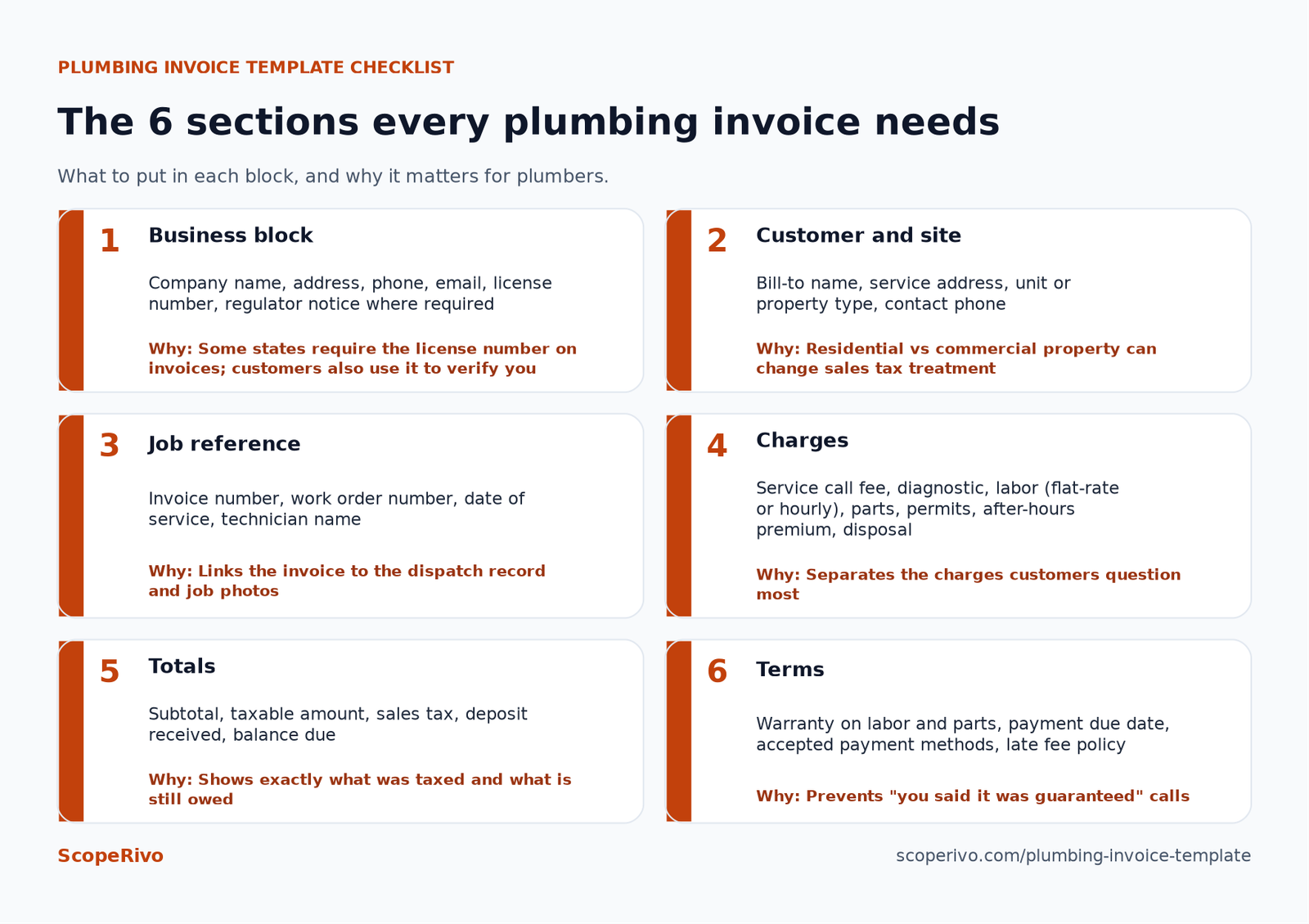
Most disputes over a plumber invoice come from three gaps: a surprise trip fee, a vague parts list, or a verbal-only warranty. A good plumbing invoice template closes those gaps on paper before the customer pays. The checklist below covers the fields that matter most, grouped by purpose.
| Section | Fields to include | Why it matters for plumbers |
|---|---|---|
| Business block | Company name, address, phone, email, license number, regulator notice where required | Some states require the license number on invoices; customers also use it to verify you |
| Customer and site | Bill-to name, service address, unit or property type, contact phone | Residential vs commercial property can change sales tax treatment |
| Job reference | Invoice number, work order number, date of service, technician name | Links the invoice to the dispatch record and job photos |
| Charges | Service call fee, diagnostic, labor (flat-rate or hourly), parts, permits, after-hours premium, disposal | Separates the charges customers question most |
| Totals | Subtotal, taxable amount, sales tax, deposit received, balance due | Shows exactly what was taxed and what is still owed |
| Terms | Warranty on labor and parts, payment due date, accepted payment methods, late fee policy | Prevents “you said it was guaranteed” calls |
Business, license and regulator details
Put your license number in the header of every plumbing invoice template you use, not only on bids. In Texas this is more than good practice. The Texas State Board of Plumbing Examiners consumer page says the written estimate and invoice should show the Responsible Master Plumber’s license number and the name, address and telephone number of the Texas State Board of Plumbing Examiners. Other states and cities set their own rules, so check your licensing board’s page and add any required notice line to the header.
Customer, job site and work order details
Your plumbing invoice template should record the bill-to party and the service address separately. Landlords, property managers and home warranty companies often pay for work at an address they do not live at. Add the property type (single-family, multifamily, commercial) because some states tax repair work differently depending on whether the property is residential. Include the work order or dispatch number so office staff can match the plumbing service invoice to the original call notes and any photos the technician took.
Line items that are specific to plumbing
Plumbing charges fall into a predictable set of buckets. A useful plumbing invoice template gives each one its own line rather than burying them in a single “labor and materials” total:
- Service call or trip fee, with a note on whether it is credited toward the repair.
- Diagnostic or inspection time, including camera inspection of a drain line.
- Labor, shown as a flat-rate task price or as hours multiplied by an hourly rate.
- Parts and materials, itemized by description, quantity and unit price.
- Permit and inspection fees passed through from the local building department.
- Emergency, after-hours, weekend or holiday premium.
- Haul-away and disposal of old fixtures or tanks.
Copy-ready plumbing invoice template (layout)
Copy the block below into your word processor, spreadsheet or invoicing tool. Square brackets mark the fields you fill in. Delete any line that does not apply to the job, but keep the terms section on every invoice.
[COMPANY NAME] - PLUMBING SERVICE INVOICE
[Street address] | [City, State ZIP] | [Phone] | [Email]
Plumbing license no.: [license number]   Responsible plumber: [name]
[Regulator notice line, if your state requires one]
Invoice no.: [INV-0000]        Invoice date: [MM/DD/YYYY]
Work order no.: [WO-0000]      Date of service: [MM/DD/YYYY]
Technician: [name]             Arrival / departure: [time] / [time]
BILL TO                        SERVICE ADDRESS
[Customer or company name]     [Street, unit]
[Billing address]              [City, State ZIP]
[Phone / email]                Property type: [Residential / Commercial]
PROBLEM REPORTED: [customer's description of the issue]
WORK PERFORMED:  [plain-English summary of what was done]
FINDINGS / RECOMMENDATIONS: [anything found but not fixed]
LINE ITEMS
Type        Description                         Qty   Rate     Amount
Service     Service call / trip fee             1     [rate]   [amt]
Diagnostic  [e.g., camera inspection of line]   1     [rate]   [amt]
Labor (FR)  [flat-rate task name]               1     [price]  [amt]
Labor (T&M) [task] - hours on site              [hrs] [rate]  [amt]
Part        [part name, size, brand/model]      [qty] [price]  [amt]
Part        [fittings, supply lines, etc.]      [qty] [price]  [amt]
Permit      [jurisdiction] permit/inspection    1     [fee]    [amt]
Premium     After-hours / emergency surcharge   1     [rate]   [amt]
Disposal    Haul-away of old [fixture/tank]     1     [rate]   [amt]
                                   Subtotal:          [amt]
                                   Taxable amount:    [amt]
                                   Sales tax ([rate]): [amt]
                                   Deposit received:  -[amt]
                                   BALANCE DUE:       [amt]
WARRANTY
Labor: [period] from date of service on work listed above.
Parts: per manufacturer warranty; registration [done / customer to do].
Not covered: [pre-existing conditions, clogs caused by misuse, etc.]
PAYMENT TERMS
Due: [on completion / Net 15 / Net 30]
Accepted: [card, ACH, check, cash]   Pay online: [link]
Late fee: [policy, if allowed in your state]
Customer signature: ____________________  Date: __________
Thank you for choosing [Company Name].
How to use the plumbing invoice template fields
The “Type” column is the part most general templates miss. Tagging each row as Service, Diagnostic, Labor, Part, Permit, Premium or Disposal makes the plumbing invoice template easier to read and lets your bookkeeper total labor and parts separately, which matters in states that tax them differently. The “Findings / Recommendations” line records problems you spotted, such as a corroded shutoff, that the customer declined to fix.
In any plumbing invoice template, use a sequential invoice number that never repeats, and keep the work order number on the invoice even if the customer never sees the work order. If you also need a plumbing bill template for a monthly property-management account, use the same layout and add a “billing period” line under the invoice date with one row per visit.
Pricing lines plumbers get wrong on a plumber invoice
The line items below cause most of the “why is this so high” calls. The fix is rarely the price itself. It is how the plumbing invoice template labels and explains each charge.
Service call or trip fee on a plumbing invoice template
A trip fee covers getting a licensed plumber and a stocked truck to the address. Say on the plumber invoice whether it is a standalone charge or credited toward approved repairs. If your policy changes after hours, say that too. Customers accept a trip fee more readily when the dispatcher mentioned it and the invoice uses the same wording. An answering service for contractors can read that disclosure on every after-hours call so the policy is stated the same way each time.
Diagnostic fee and whether it is credited
Separate diagnosis from repair in your plumbing invoice template. A camera inspection, leak detection or water pressure test is real work even if the customer decides not to proceed. On the plumbing invoice template, show diagnostic time as its own row and note whether it was waived because the customer approved the repair. That single note answers the most common follow-up question.
Flat-rate vs time-and-materials lines
Plumbing companies usually price one of two ways, and many use both depending on the job. The plumbing invoice template layout above includes a row for each so you can delete the one you do not use.
| Approach | How the line reads | Best fit | Invoice tip |
|---|---|---|---|
| Flat-rate | One task price, e.g. “Replace toilet fill valve” | Repeatable repairs with predictable time | List the task name exactly as quoted; parts may be included in the price |
| Time-and-materials | Hours on site multiplied by hourly rate, plus itemized parts | Unknowns: hidden leaks, old galvanized lines, remodel work | Show arrival and departure times and round hours by a stated rule |
| Hybrid | Flat-rate core task plus T&M for extra work found | Jobs where the scope changes after opening a wall | Get written approval for the T&M portion before starting it |
Whichever you choose, match the invoice to the estimate. Do not switch a flat-rate quote to hourly without a signed change.
Parts and markup on a plumbing invoice template
You do not have to print your markup as a separate line. Most plumbers list parts at the sell price, with description, size and quantity, and keep cost and markup in their own records. What you should show is enough detail for the customer to identify each part: “50-gal natural gas water heater, [brand/model]” rather than “water heater.” Where a commercial account requires cost-plus billing, add a cost column and a stated markup rate.
Permits and inspection fees
Many local building departments require a permit for jobs such as water heater replacement, new gas lines or repiping. When you pull one, put the permit fee on its own line labeled with the jurisdiction and permit number. Keep a separate row for your time to obtain the permit and meet the inspector if you charge for it. Never pad the permit line in your plumbing invoice template; customers can look up the actual fee.
Emergency and after-hours rates in your plumbing invoice template
Show emergency pricing as a separate premium line or as a different labor rate, not as an unexplained higher total. Define the hours your after-hours rate applies to in your terms and use the same definition on your website, dispatch script and plumbing invoice template. A clearly labeled surcharge keeps the conversation about the repair rather than the bill.
Two worked examples: drain call vs water heater install
The same plumbing invoice template handles very different jobs. The examples use placeholders instead of dollar figures because rates vary by market.
Example 1: Drain cleaning on a plumbing invoice template
PROBLEM REPORTED: Kitchen sink draining slowly, backs up into second bowl.
WORK PERFORMED: Cleared kitchen branch line with cable machine from
cleanout. Ran hot water 10 minutes, verified flow.
FINDINGS: Grease buildup; recommended camera inspection if it recurs.
Type        Description                          Qty   Rate     Amount
Service     Service call / trip fee              1     [rate]   [amt]
Labor (FR)  Clear kitchen drain via cleanout     1     [price]  [amt]
Premium     After-hours (call at 8:40 p.m.)      1     [rate]   [amt]
WARRANTY: Labor on this drain clearing: [period]. Not covered:
reblockage caused by grease, wipes or foreign objects.
This plumbing service invoice has no parts, permit or diagnostic line. The findings line records the recommendation so a repeat call can start with a camera inspection.
Example 2: Water heater replacement
PROBLEM REPORTED: Tank leaking at base; no hot water.
WORK PERFORMED: Drained and removed existing 40-gal gas tank. Installed
new 40-gal gas water heater, new flex connectors, expansion tank and
T&P discharge line. Tested for gas leaks, lit pilot, verified draft.
PERMIT: [jurisdiction] permit no. [number]; inspection [date/pending].
Type        Description                          Qty   Rate     Amount
Diagnostic  Leak and draft inspection            1     [rate]   [amt]
Labor (FR)  Replace gas tank water heater        1     [price]  [amt]
Part        40-gal gas water heater [brand/model] 1    [price]  [amt]
Part        Expansion tank [size]                1     [price]  [amt]
Part        Gas and water flex connectors        3     [price]  [amt]
Permit      [jurisdiction] plumbing/gas permit   1     [fee]    [amt]
Disposal    Haul-away of old tank                1     [rate]   [amt]
                                   Deposit received:  -[amt]
WARRANTY: Labor [period]. Tank per manufacturer warranty; serial
no. [number] registered on [date] by [company / customer].
This job uses nearly every row in the plumbing invoice template. Recording the serial number and who registered the warranty saves time if the tank fails later. The deposit row matters too: in California, the Contractors State License Board notes that a down payment cannot exceed 10 percent of the project price or $1,000, whichever is less, for home improvement work. Check your own state’s deposit rules.
Sales tax on parts vs labor: plumbing invoice template rules by state
Sales tax is where a copied plumbing invoice template can do real harm, because the rules differ sharply by state and sometimes by property type. Some states tax only the parts, some tax the entire repair charge, and some exempt labor on residential repairs. Your template should therefore keep labor and parts on separate lines and show the taxable amount before tax is calculated. Two state examples show how far apart the rules can be.
Texas: residential vs nonresidential repairs
The Texas Comptroller’s guide to real property repair and remodeling states that “labor to repair, remodel, or restore residential real property is not taxable.” For commercial work it says the total amount charged for remodeling, repairing, or restoring nonresidential real property is taxable. The same guide explains that contract type matters, including that under a separated contract, you give your suppliers resale certificates instead of paying tax on materials you incorporate. That is why the property type field belongs on a Texas plumber invoice.
Washington: repair work as a retail service
Washington takes a broader approach. The Department of Revenue’s retail sales tax page lists repairing or improving real property for consumers among taxable retail services. In practice that means a Washington plumbing service invoice for a homeowner typically calculates sales tax on the full charge, not only the parts. Confirm the rate for the job location, because local rates apply.
Everywhere else
Do not assume either example applies to you. Look up your state revenue department’s guidance for contractors or repair services, note whether it distinguishes labor from materials, and set your plumbing invoice template or software tax settings to match.
Warranty and payment terms on a plumbing service invoice
Terms printed on the invoice are the ones customers remember. Keep them short and identical in every copy of your plumbing invoice template.
Warranty wording that holds up
State the labor warranty period, what it covers and what it excludes. Point parts coverage to the manufacturer’s warranty and say who is registering it. The Texas plumbing board advises consumers to make sure that all warranties and cost estimates are in writing, so assume customers in any state will ask for it on paper. Avoid words like “lifetime” unless you have a written policy behind them.
Payment terms, deposits and late fees
For residential service calls, “due on completion” is common and easy to enforce when the technician can take card payment on site. For property managers and commercial accounts, state Net terms with a calendar due date and list accepted payment methods. If you charge late fees, make sure your state allows them and that the customer saw the policy before the work began.
On any plumbing invoice template, print the balance due and due date in the largest type, and show a deposit as a negative line.
Recordkeeping after the plumber invoice is paid
An invoice is also a tax record. The IRS explains on its small business recordkeeping page that purchases, sales, payroll, and other transactions you have in your business generate supporting documents. For a plumbing company, those documents include each invoice, the supplier receipts for the parts on it, permit receipts and payment confirmations.
How long should you keep them? The IRS says you must keep your records as long as needed to prove the income or deductions on a tax return, and the right period depends on the type of record. A simple routine works for most small shops:
- Save every invoice made from your plumbing invoice template as a PDF named by invoice number.
- Attach supplier receipts to the job record so parts cost matches the parts billed.
- Keep permit numbers, inspection results and warranty registrations with the job.
- Reconcile paid invoices against bank deposits each week.
- Back up each plumbing invoice template file and export to a second location.
When to move from a plumbing invoice template to software
A copy-and-paste plumbing invoice template works well for a one-truck shop sending a handful of invoices a week. It starts to strain when you dispatch several technicians, need invoices created on site from the work order, or want card payments collected before the truck leaves. Field service tools turn your plumbing invoice template into a form filled from the job record, with tax settings and payment links.
If you are weighing that step, start with our guide to field service software for small business, which compares tools on scheduling, invoicing and payments. If you already use Jobber and want other options, see our roundup of Jobber alternatives. Whatever you choose, rebuild your custom invoice from this layout inside the software: license header, typed line items, property type for tax, warranty and payment terms.
Until then, keep this plumbing invoice template as your standard, update it whenever your state rules or pricing policy change, and make sure every technician uses the same version.
Related guides
- Plumbing Software: Best Field Service Apps for Plumbers Compared (2026)
- Plumbing Estimating Software: Best Options for Small Plumbing Businesses (2026)
- How to Start a Plumbing Business: Licenses, Costs and First-Year Checklist (2026)
- Free Cleaning Invoice Template for Residential and Commercial Jobs (2026)
Frequently asked questions
What should a plumbing invoice template include?
At minimum: your company name, license number, customer and service address, invoice and work order numbers, service date, separate lines for trip fee, diagnostic, labor, parts, permits and after-hours premiums, sales tax, deposit, balance due, warranty terms and payment terms. Add any notice line your state licensing board requires.
Do plumbers have to put their license number on an invoice?
It depends on the state. Texas plumbing rules call for the Responsible Master Plumber’s name and license number plus board contact details on invoices. Other states set different requirements, so check your licensing board. Including it everywhere is a sensible default for any plumber invoice.
Should I charge sales tax on plumbing labor?
Rules vary by state. Texas does not tax labor on residential repairs but taxes nonresidential repair charges, while Washington treats repair of real property for consumers as a taxable retail service. Check your state revenue department and keep labor and parts on separate lines of your plumbing invoice template.
Do I need to show my parts markup on a plumbing service invoice?
Generally no. Most plumbers list parts at the sell price with a clear description, size and quantity. Show cost and markup only when a contract or commercial account requires cost-plus billing. Be consistent across customers on similar jobs.
Is a plumbing bill template different from an invoice?
In everyday use the terms mean the same thing. A plumbing bill template is often used for recurring or account billing, such as monthly property-management work. You can use the same plumbing invoice template and add a billing period and one row per visit.
How long should I keep invoices made from a plumbing invoice template?
The IRS says to keep records as long as needed to prove the income or deductions on a tax return, and the period depends on the record type. Keep invoices with their supplier receipts, permits and payment records, and confirm retention periods with your tax professional.