Free Cleaning Invoice Template for Residential and Commercial Jobs (2026)
Last updated October 25, 2026. This guide uses the official Invoice Simple and Jobber pricing pages plus IRS, BLS and SBA pages, all checked on October 25, 2026; pricing examples use illustrative numbers. ScopeRivo may earn a commission from some links; read our affiliate disclosure.
A cleaning invoice template is a ready-made bill that lists who you cleaned for, where and when, each service with its rate, any add-ons, tax if your state requires it, the total, and how and when to pay. Residential cleaners usually invoice per visit; commercial cleaners usually bill a recurring monthly amount. Both free templates are below.
Which cleaning invoice template do you need?
The right cleaning invoice template layout depends on how often you clean for the client and who pays the bill. A homeowner paying after each visit wants a short, clear receipt. An office manager passing your bill to accounts payable needs a purchase order number, a billing period and a running balance.
| Situation | Use this template | Key fields |
|---|---|---|
| One-time, move-out or deep clean | Residential per visit | Service date, add-ons, extra time approved |
| Weekly or biweekly home cleaning | Residential per visit (or monthly batch) | Visit date, recurring rate, cancellation terms |
| Office, retail or medical suite on a contract | Commercial recurring monthly | Billing period, PO number, visits, credits, balance |
| Post-construction or one-off commercial job | Commercial, with the one-time section only | Work order number, square footage, scope |
Template 1: residential cleaning invoice template (per visit)
Use this house cleaning invoice for regular home cleaning, apartment turnovers and move-out cleans. It records crew and time on site, which helps when a client asks what was done or questions an extra-time charge.
CLEANING INVOICE - RESIDENTIAL (PER VISIT)
[Business name]
[Address]  |  [Phone]  |  [Email]  |  [Website]
[Business license or registration no., if your city requires one]

Invoice no.: [CL-YYYY-####]       Invoice date: [MM/DD/YYYY]
Service date: [MM/DD/YYYY]        Due date: [MM/DD/YYYY]
Quote / booking ref.: [ ]

BILL TO                           SERVICE ADDRESS
[Client name]                     [Street]
[Billing address]                 [City, state, ZIP]
[Phone / email]                   Entry notes: [key, code, pets]

SERVICES PERFORMED
Description                               Qty    Rate       Amount
------------------------------------------------------------------
Standard clean - [3 bed / 2 bath],
  kitchen, baths, dusting, floors          1     [flat]     [amount]
Add-on: inside oven                        1     [rate]     [amount]
Add-on: inside refrigerator                1     [rate]     [amount]
Add-on: interior windows ([__] panes)     [__]   [rate]     [amount]
Extra time (approved by client)           [__]h  [rate]     [amount]
Supplies / special products, if billed                      [amount]

Crew on site: [names or initials]   Time in: [ ]   Time out: [ ]

Subtotal                                                    [amount]
Discount ([reason])                                        -[amount]
Sales tax, if your state taxes cleaning services            [amount]
TOTAL DUE                                                   [amount]

PAYMENT
Pay by: [card link / ACH / check payable to ...]
Terms: due [on receipt / within __ days]
Late fee: [your stated fee, within your state's limits]
Cancellation: [notice required and any lockout fee]

Notes: [anything not completed and why, or items to address next visit]
Thank you for your business.
Template 2: commercial cleaning invoice template (recurring monthly)
This cleaning invoice template is built for contract janitorial work. Written as a janitorial invoice, it ties each bill to a service agreement, separates recurring visits from approved one-time work, and shows credits for missed visits so the client’s accounts payable team can match it against the contract without calling you.
CLEANING INVOICE - COMMERCIAL (RECURRING MONTHLY)
[Business name]  |  [Address]  |  [Phone]  |  [Email]
[License / registration no.]   [Certificate of insurance on file: yes/no]

Invoice no.: [CM-YYYY-MM-##]     Invoice date: [first business day]
Billing period: [MM/01/YYYY] to [last day of month, MM/DD/YYYY]
Due date: [net __ days]           Client PO no.: [ ]
Service agreement ref.: [agreement no., start date]

BILL TO                           SITE
[Company name]                    [Site name, address]
Attn: [accounts payable contact]  Site contact: [name, phone]
[AP email]                        Cleanable area: [____] sq ft

RECURRING SERVICE
Description                       Visits   Rate/visit   Amount
---------------------------------------------------------------
Nightly janitorial, [days]         [__]    [rate]       [amount]
  (trash, restrooms, breakroom,
   vacuum, hard-floor mop)
Restroom consumables restock       [__]    [rate]       [amount]
                    -- or --
Monthly contract price, per agreement                  [amount]

ADDITIONAL / ONE-TIME WORK (approved in writing)
[Date]  [Carpet extraction, __ sq ft]  WO no. [__]     [amount]
[Date]  [Strip and wax, __ sq ft]      WO no. [__]     [amount]

CREDITS
[Date]  [Missed visit - holiday closure]              -[amount]

Subtotal                                               [amount]
Sales tax, if applicable in your state                 [amount]
TOTAL DUE                                              [amount]

Previous balance: [amount]   Payments received: [amount]
BALANCE DUE: [amount]

Remit to: [ACH details on request / mailing address]
Late payment: [terms from the service agreement]
Questions about this invoice: [name, phone, email]
If your client manages several sites, send one invoice per site or add a site column; accounts payable departments often code costs by location.
Field-by-field guide
Every field on a cleaning invoice template exists to answer a question before the client has to ask it. Here is what to put in each one and why it matters.
| Field | What to enter | Why it matters |
|---|---|---|
| Invoice number | A unique, sequential number with a prefix (CL for residential, CM for commercial) | Lets you and the client reference one bill without confusion and keeps your records in order |
| Invoice and due dates | Date issued and the exact date payment is due | “Net 15” is easy to misread; a calendar date is not |
| Service date or billing period | The visit date, or the first and last day covered | Ties the charge to work the client can verify |
| Service address | Where the cleaning happened, if different from billing | Property managers and landlords often pay for many addresses |
| Line items | One service per line with quantity, rate and amount | Clients pay faster when they can see what each charge is for |
| Add-ons and extra time | Separate lines, marked as approved | Prevents disputes over charges the client did not expect |
| Credits | Missed visits, discounts or goodwill adjustments | Shows good faith and keeps contract totals accurate |
| Tax | Only if your state or locality taxes the service | Charging tax you do not owe, or skipping tax you do, both create problems |
| Payment instructions | Accepted methods, payee name, link if you take cards online | The fewer steps to pay, the sooner the money arrives |
| Terms | Due date, late fee and cancellation rules | Terms printed on every invoice are easier to enforce than ones mentioned once |
Writing line items clients understand
On a cleaning invoice template, vague lines like “cleaning services” invite questions. Specific ones answer them. Compare these:
- Instead of “Cleaning,” write “Standard clean: kitchen counters and appliance fronts, two bathrooms, dusting, vacuum and mop all floors.”
- Instead of “Extra,” write “Inside oven, add-on requested at booking.”
- Instead of “Office cleaning – October,” write “Nightly janitorial, Monday to Friday, 22 visits, per service agreement dated March 1.”
- Instead of “Adjustment,” write “Credit: no service on holiday closure, one visit.”
Recording notes and exceptions
Use the notes line of the cleaning invoice template for anything that did not go as planned: a room that was locked, a pet that prevented access, or supplies the client ran out of. A one-line note today saves a ten-minute phone call next week and gives you a written record if a dispute ever comes up.
How to price cleaning services on an invoice
Cleaning businesses generally charge in one of three ways. Your cleaning service rates and the method behind them shape how your cleaning invoice template reads, so pick the one that matches the agreement you made with the client. The examples below use illustrative dollar amounts to show the math only; set your own rates from your labor, supply and overhead costs and your local market.
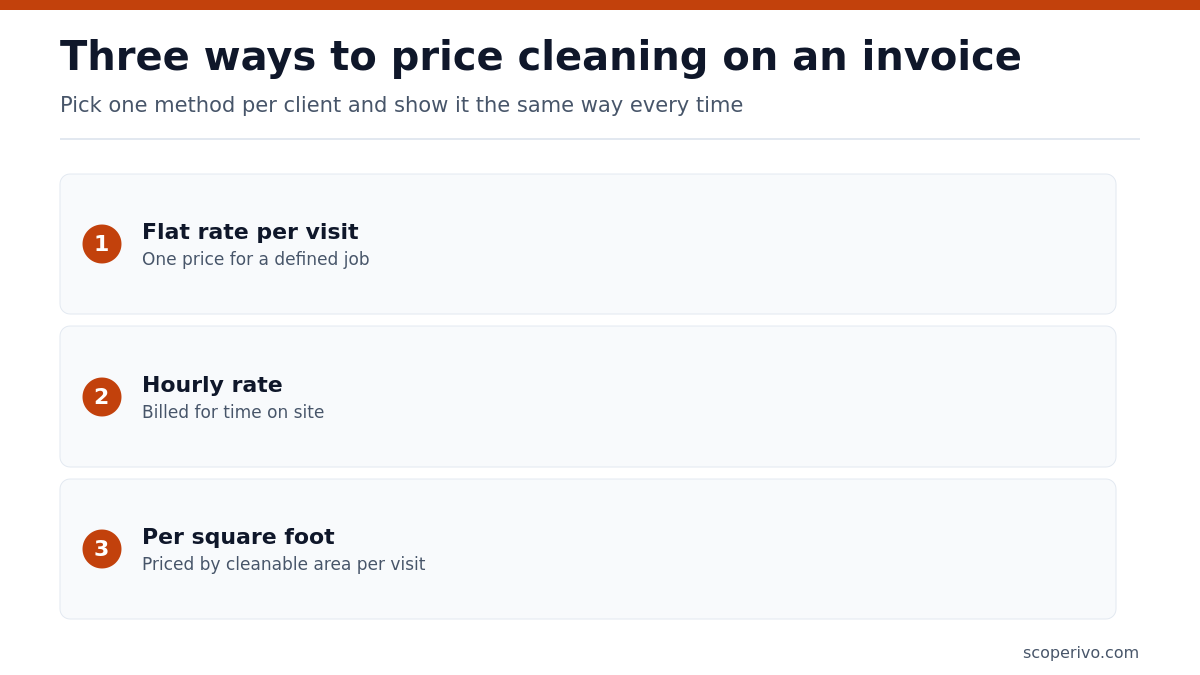
Flat rate per visit
You quote one price for a defined job. Example: a three-bedroom, two-bathroom home typically takes your crew about 3.5 labor hours. If your target is 50 dollars per labor hour to cover wages, payroll costs, supplies, travel and profit, that is 175, plus 10 for supplies, for a flat rate of 185 per standard clean. The invoice shows one line, “Standard clean, 3 bed / 2 bath: 185,” with any add-ons listed separately.
Flat pricing is easy for clients to accept and rewards an efficient crew. The risk is homes that turn out dirtier than expected, so state what “standard” includes and price heavy first-time cleans as a separate deep clean.
Hourly rate
You bill for time on site. Example: two cleaners work two hours each, for four labor hours at 45 per labor hour, giving 180. The invoice should show the number of cleaners, time in and time out, and the hourly rate, so the client can check the math.
Hourly billing suits unpredictable jobs such as post-party cleanups or hoarding situations. Clients sometimes worry about slow work, so record start and finish times and agree on an estimated range in advance.
Per square foot (common for commercial work)
You price by cleanable area per visit. Example: a 4000 square foot office at 0.09 per square foot per visit comes to 360 per visit. At three visits a week, that is 156 visits a year, or 13 visits a month on average, so the monthly contract price is 13 x 360 = 4680. The commercial cleaning invoice template lets you show either the per-visit math or the agreed monthly figure.
Per-square-foot pricing works best when you have walked the space and know the floor types, restroom count and traffic. Adjust the rate for restrooms, kitchens and heavily used areas rather than applying one figure to the whole building.
Payment terms, deposits and late fees
Clear terms get you paid faster. Put them on every cleaning invoice template you send, not only in the original agreement.
- Residential: many cleaners ask for payment on the day of service or on receipt, often by card on file. Say so at booking and repeat it on the invoice.
- Commercial: businesses usually expect net terms. Agree the number of days in the service agreement and print the actual due date.
- Cancellations: if you charge a lockout or late-cancellation fee, state the notice period and the amount in writing before the first visit.
- Late fees: a late fee must be agreed in advance and stated on the invoice to be credible. Some states and cities limit late fees or interest charges, so check your state’s consumer protection or attorney general guidance before setting one.
Send reminders before the due date, on it, and a week after. A polite reminder with the invoice attached resolves most late payments without any fee at all.
Sales tax on cleaning services
Whether you charge sales tax on cleaning depends on where you work. Some states tax certain cleaning or janitorial services and others do not, and rules can differ between residential and commercial work. The SBA’s licenses and permits guide notes that income tax, sales tax, property tax, and corporate taxes can vary significantly from place to place. Check your state department of revenue website, or ask a tax professional, before adding a tax line to your cleaning invoice template. This guide does not give tax advice.
Keep cleaning invoice records the IRS way
Your invoices are part of your tax records. According to the IRS recordkeeping page, good records help you identify sources of income and keep track of deductible expenses. The IRS page on what kind of records to keep lists that documents for gross receipts include cash register tapes, deposit information, receipt books and invoices, which means every cleaning invoice template you send becomes a supporting document for your income.
How long to keep invoices
The IRS guidance on how long to keep records says to keep records for 3 years if none of the special situations listed on that page apply to you, with longer periods in specific cases described there. If you have employees, keep employment tax records for at least 4 years after the date that the tax becomes due or is paid, whichever is later. The same page also warns that your insurance company or creditors may require you to keep them longer than the IRS does, so check those requirements too before discarding anything.
Paper or digital
Digital invoices are fine, but the IRS states that all requirements that apply to hard copy books and records also apply to electronic records. Back up your invoice files, keep them in date order, and make sure you can still open them if you change software.
Cleaning labor costs in context
Labor is usually the biggest cost behind every price on a cleaning invoice. For broad context, the Bureau of Labor Statistics janitors and building cleaners page reports that the median hourly wage for janitors and building cleaners was $17.71 in May 2025. It also notes that work schedules may vary to include evenings, nights, or weekends, which is why commercial invoices often cover after-hours visits. National medians are only a reference; build your rates from what you actually pay your team in your area, plus payroll costs.
Checklist before you send a cleaning invoice
Run through this list each time you fill in a cleaning invoice template. It takes about a minute and catches most of the slips that delay payment.
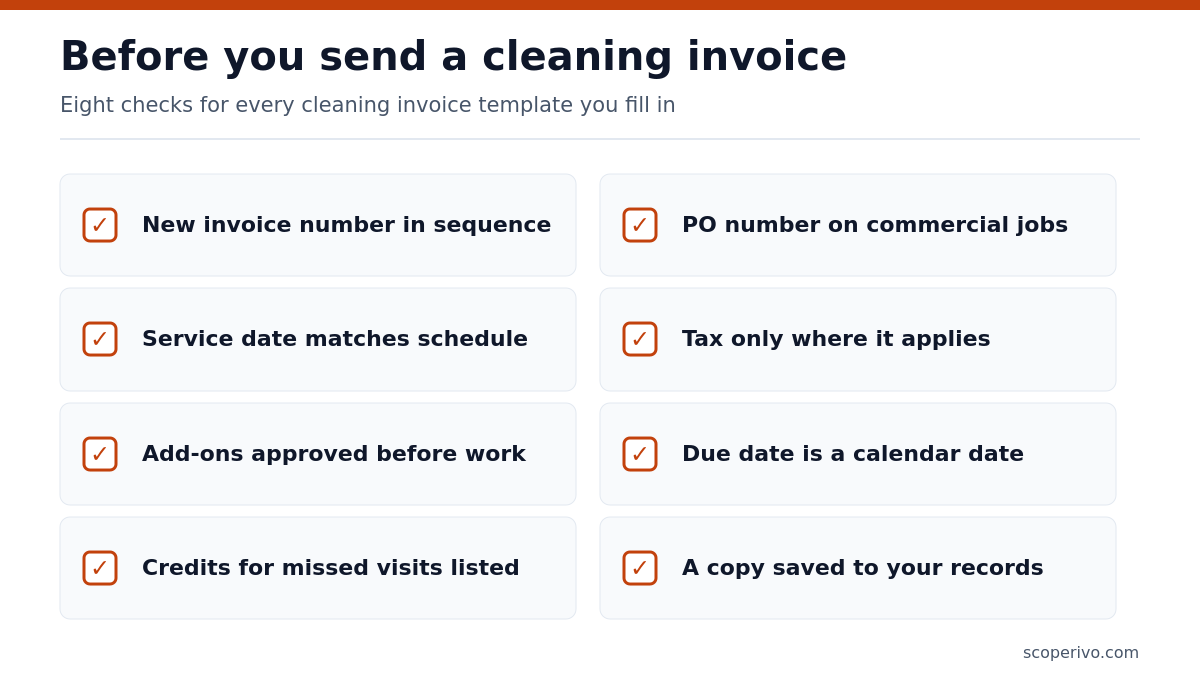
- The invoice number is new and follows your sequence, with no gaps or repeats.
- The service date or billing period matches your schedule and the crew’s time records.
- Every add-on and extra-time line was approved by the client before the work was done.
- Credits for missed or shortened visits are listed, not silently left off.
- The commercial version carries the client’s PO number and service agreement reference.
- Tax appears only if your state and locality actually tax the service.
- The due date is a calendar date, and payment instructions include a working link or remit address.
- You saved a copy of the finished cleaning invoice template in your records folder before sending it.
If something on the list is unclear, fix it before the invoice goes out. Correcting a sent invoice means issuing a revised one, explaining the change, and often waiting another payment cycle.
When to switch from a template to invoicing software
A cleaning invoice template in a document or spreadsheet works well while you invoice a few clients a week. Consider software when you keep retyping the same recurring clients, chase late payments by hand, or want card payments and automatic reminders. Two published price points, as of October 25, 2026, illustrate the range.
Invoice Simple: invoicing only
Invoice Simple’s official pricing page sorts plans by monthly invoice volume, as of October 25, 2026:
- Essentials is listed at $6.99 /mo for up to 3 invoices per month.
- Plus is listed at $14.99 /mo for up to 10 invoices per month.
- Premium is listed at $21.99 /mo with unlimited invoices per month.
The page also says the mobile free trial gives 14-day full access to the Premium plan. Annual billing is offered as well; check the page for the yearly figures before you subscribe.
Jobber: scheduling plus invoicing
If you also need scheduling, quotes and a client portal, field service software for small businesses bundles invoicing with those tools. As of October 25, 2026, Jobber lists its Core plan for one user at $49/mo on standard monthly billing, and the page also shows introductory discounts and annual options. See Jobber’s pricing page for current terms.
| Plan (as of October 25, 2026) | Listed monthly price | Limit or scope |
|---|---|---|
| Invoice Simple Essentials | 6.99 USD | Up to 3 invoices per month |
| Invoice Simple Plus | 14.99 USD | Up to 10 invoices per month |
| Invoice Simple Premium | 21.99 USD | Unlimited invoices per month |
| Jobber Core | 49 USD (standard monthly) | 1 user; scheduling, quotes, invoicing |

For a broader comparison of scheduling and billing tools for maid services and janitorial companies, read our guide to cleaning business software. If you already keep your books in QuickBooks, our QuickBooks for contractors guide explains how its invoicing fits service businesses. Trade businesses may also find our contractor invoice template and plumbing invoice template useful for comparing layouts.
What to ask before you pay for invoicing software
- Can it send recurring invoices automatically on a set day each month?
- Does it support online card and bank payments, and what processing fees apply?
- Can I add my own line items and reuse them for every client?
- Will it export invoices and payment history if I switch tools later?
How we compiled this guide
This cleaning invoice template guide is for US residential and commercial cleaning businesses. Software prices come only from the official Invoice Simple and Jobber pricing pages; recordkeeping points from the IRS recordkeeping, “what kind of records” and “how long should I keep records” pages; labor context from the BLS Occupational Outlook Handbook; and the sales tax note from the SBA licenses and permits guide. All pages were checked on October 25, 2026. Pricing examples are illustrative, not market rates.
Frequently asked questions
What should a cleaning invoice template include?
It should include your business name and contact details, a unique invoice number, invoice and due dates, the client’s billing and service addresses, the service date or billing period, itemized services with rates, add-ons, credits, sales tax if it applies, the total due, payment methods and your late-fee and cancellation terms.
Should I charge cleaning clients hourly or a flat rate?
Flat rates work well for repeat residential cleans with a defined scope, because clients like a predictable price and efficient crews earn more. Hourly rates suit unpredictable jobs such as heavy first-time or post-event cleanups. Commercial accounts are often priced per square foot and billed as a fixed monthly amount.
How do I invoice a recurring commercial cleaning client?
Send one invoice per billing period, usually monthly, that references the service agreement and the client’s purchase order number. List recurring visits or the monthly contract price, add approved one-time work on separate lines, show credits for missed visits, and carry forward any previous balance so accounts payable can reconcile it quickly.
Do cleaning businesses charge sales tax?
It depends on the state, and sometimes the city. Some states tax certain cleaning or janitorial services while others do not, and treatment can differ between homes and businesses. Check your state department of revenue website or speak with a tax professional before you add a sales tax line to your invoices.
How long should I keep cleaning invoices?
The IRS generally ties record retention to the period of limitations for the related tax return, commonly three years, with longer periods in certain situations and at least four years for employment tax records. Review the IRS page on how long to keep records, and check whether insurers or lenders require longer.
When are cleaning invoices usually due?
Residential cleaning is often paid on the day of service or on receipt, frequently by a saved card. Commercial clients usually pay on net terms agreed in the service contract. Whatever you choose, print an exact due date on every cleaning invoice template and send a reminder shortly before it arrives.