
Snow Removal Contract Template: Clauses and Sample Wording (2026)
Last updated November 1, 2026. This template was written from official OSHA winter weather, cold stress and fall protection pages and the IRS recordkeeping page, checked on November 1, 2026. ScopeRivo may earn a commission from some links; read our affiliate disclosure.
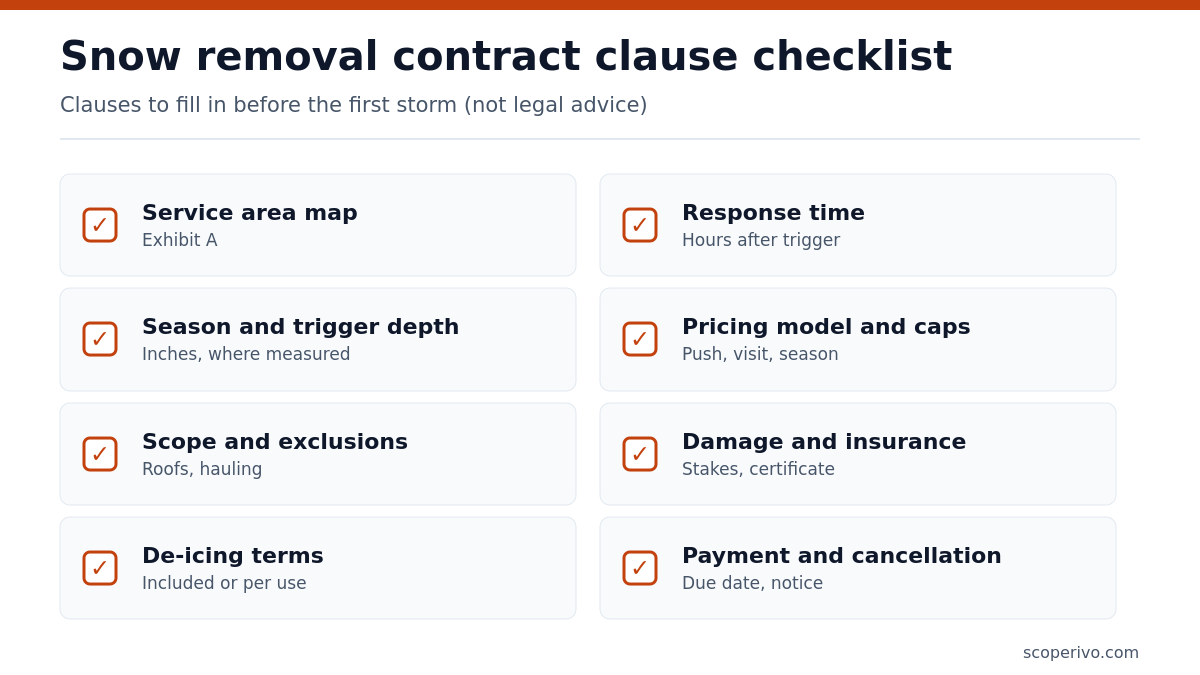
A snow removal contract template is a fill-in agreement that sets the service area, the snow depth that triggers a visit, how you charge (per push, per visit or seasonal), de-icing, response times, damage rules, insurance, payment and cancellation. Below you get a clause checklist, plain-English sample wording and a copy-ready snow removal contract template you can adapt for homes or commercial lots.
This is not legal advice. Contract rules, consumer protection laws and lien rights vary by state, and sometimes by city. Use this snow removal contract template as a starting draft, then have a local attorney review the final version before you send it to clients.
What a snow removal contract template must cover
Snow disputes often come from three gaps: the client expected service at a lower depth, nobody agreed on what “cleared” means, or a plow hit something buried under the snow. A good snow removal contract template closes those gaps before the first storm. The table is the short version; sample wording follows below.
| Clause | What it settles | What you fill in |
|---|---|---|
| Parties and service area map | Who is bound and exactly which surfaces you clear | Names, address, attached site map |
| Season and trigger depth | When the contract runs and how much snow starts a visit | Start and end dates, [trigger depth] inches |
| Scope of work | Plowing, shoveling, walks, steps, snow stacking, hauling | Checked list of included and excluded tasks |
| De-icing | Whether salt or other melt is included and how it is billed | Product type, per-application rate or “included” |
| Response time | How soon after the trigger you arrive and in what order | [number] hours, priority order |
| Pricing model | Per push, per visit, hourly or seasonal | [amount] placeholders, caps |
| Damage and obstacles | Marking stakes, hidden objects, turf damage, reporting window | Reporting deadline in days |
| Liability and insurance | Who carries what coverage, certificates | [coverage type] and [limit] placeholders |
| Payment terms | Invoice timing, due date, late fees where lawful | Net [number] days |
| Cancellation and termination | How either side ends the agreement and what is owed | Notice period, refund rule |
Residential vs commercial snow removal agreements
One snow removal contract template can serve both markets, but the emphasis shifts. Homeowners want the car out in the morning. Property managers care about liability, documented service times and walkways that stay passable during business hours.
Residential driveway contracts
Keep the residential version of your snow removal contract template short, usually one or two pages. Spell out the driveway, the front walk, the steps and whether you clear the mailbox approach or the snow left by the city plow at the end of the drive. That ridge is easy to forget, so name it. Homeowners also need to know whether parked cars will be worked around or whether they must move them before a set time.
Commercial lot contracts
A snow plowing contract for a retail lot, office park or apartment complex needs more detail: a site map with numbered zones, a priority order (fire lanes and entrances first), where snow may be stacked, whether you must clear before opening hours, and how you log each visit. Commercial clients often send their own contract; compare it clause by clause with your snow removal contract template before you sign.
| Issue | Residential | Commercial |
|---|---|---|
| Trigger depth | Often a single depth for the whole site | Lots and walkways can have separate depths |
| Response window | “By a set morning time” is common | Hours after the trigger, by zone |
| Proof of service | Text or app notification | Time-stamped logs, photos |
| Insurance | Client may ask | Certificate usually required |
Pricing models: per push, per visit and seasonal
Your snow removal contract template should support whichever model you sell, with the rate left as a placeholder. ScopeRivo does not publish “typical” snow prices because no official source tracks them; fill in your own numbers.
Per-push pricing
With per-push pricing, the client pays [amount] each time you plow once the trigger depth is reached. Define a “push” in writing: one full clearing of the contracted area. Add a line for long storms, for example a second push billed when another [trigger depth] inches falls after the first clearing. Per-push pricing suits clients who would rather pay only when it snows.
Per-visit and hourly pricing
Per-visit pricing bundles a visit with set tasks (plow, shovel walks, apply melt) for [amount]. Hourly pricing charges [amount] per hour per machine or worker and suits hauling or heavy events; say how time is recorded.
Seasonal contracts
A seasonal snow contract charges a flat [amount] for the whole season, often split into equal monthly installments. It gives you predictable revenue and gives the client a known budget. Protect yourself with a cap: for example, the flat fee covers up to [number] pushes or [number] total inches, and anything beyond is billed at the per-push rate. Without a cap, a heavy winter can turn a seasonal contract into a loss.
Choosing a pricing model for your snow removal contract template
| Model | Best for | Main risk for you | Clause you must add |
|---|---|---|---|
| Per push | Clients who want to pay only when it snows | Light winters mean light revenue | Definition of a push and re-service depth |
| Per visit | Small sites with a fixed task list | Scope creep during visits | Task list per visit |
| Hourly | Hauling, big events, unknown sites | Client disputes over time | How time is logged |
| Seasonal | Budget-focused clients and property managers | Heavy winters | Push or depth cap with overage rate |
If you are pricing your first season, our contractor proposal template shows how to present options side by side so the client picks a model instead of haggling over a single number.
Snow removal contract template clause checklist with sample wording
Work through each clause of the snow removal contract template in order. The sample wording is plain English on purpose; clients sign faster when they understand what they are agreeing to. Replace anything in square brackets.
1. Parties, property and service area map
Name both parties, the service address and the surfaces covered. Attach a simple map or marked-up aerial photo and refer to it in the text.
Sample wording: “Contractor will clear snow from the areas shaded on the attached Service Area Map (Exhibit A) only. Areas not shaded are not included unless both parties agree in writing.”
2. Season dates and trigger depth
State when the agreement starts and ends, and the snow depth that starts a visit. Say how depth is measured (for example, at a named spot on the site) so nobody argues over a drift.
Sample wording: “This agreement runs from [start date] to [end date]. Service begins when [trigger depth] inches of snow has accumulated, measured at [location]. Contractor may also apply de-icing material at lower accumulations if ice is present and Client has approved de-icing.”
3. Scope of work and exclusions
List each task as included or excluded: plowing, shoveling walks and steps, snow blowing, clearing around hydrants, snow stacking, hauling snow off site and roof snow. Some operators exclude rooftop work entirely; if you include it, read the OSHA section below first.
4. De-icing and melt products
Say which product you use, where it is applied and whether it is included or billed per application at [amount]. If a client is worried about concrete, plants or pets, record any product they ask you to avoid.
Sample wording: “De-icing is [included / billed at [amount] per application]. Client acknowledges that de-icing reduces but does not remove the risk of ice, and that ice can re-form after Contractor leaves.”
5. Response time and service order
Promise a window you can actually meet across every client on your route. “Within [number] hours after the trigger depth is reached” is clearer than “promptly.” For commercial lots, add a priority order.
6. Damage, obstacles and marking
Ask the client to mark curbs, landscape edges, drains, sprinkler heads and low walls with stakes before the first snowfall, and say who installs them. Then set a reporting window.
Sample wording: “Client will report any damage in writing within [number] days of the service visit. Contractor is not responsible for damage to unmarked objects hidden by snow, or for normal turf scarring along drive edges.”
7. Liability and insurance
Leave coverage types and limits as placeholders and fill them in with your insurance agent. State who provides a certificate of insurance and when. Avoid promising a surface that is “free of ice” at all times; describe the work you will perform instead.
Sample wording: “Contractor will maintain [coverage type] insurance with limits of at least [limit] and will provide a certificate on request. Client remains responsible for monitoring the property between visits and for notifying Contractor of hazards.”
8. Payment terms
Set when you invoice (after each push, monthly or by installment), when payment is due and how clients pay. Late fees are regulated in some states, so ask your attorney first. Our contractor invoice template covers the fields to put on each bill.
9. Cancellation and termination
Explain how either party can end the agreement, how much notice is needed and what happens to prepaid seasonal fees. A fair approach is a pro-rated refund of unused months minus services already performed.
If you sign residential customers at their home, check the Federal Trade Commission's Cooling-Off Rule. It is published as 16 CFR Part 429 and can apply to certain consumer sales made at the buyer's home or at another place that is not the seller's normal place of business. When it applies, it sets specific cancellation-notice requirements. Read the rule text yourself, or ask your attorney, to decide whether it covers how you sell and what your paperwork must include.
Copy-ready snow removal contract template
Copy this snow removal contract template into your word processor, replace every bracketed field and delete the clauses that do not apply.
SNOW REMOVAL SERVICE AGREEMENT

1. PARTIES
Contractor: [business name], [address], [phone], [email]
Client: [client name], [service address], [phone], [email]

2. TERM
This agreement runs from [start date] to [end date] (the "Season").

3. SERVICE AREA
Contractor will service only the areas shown on Exhibit A (Service Area Map):
[ ] Driveway   [ ] Parking lot zones [list]   [ ] Walkways   [ ] Steps
[ ] Entrances  [ ] Fire lanes   [ ] Other: [describe]
Excluded: [roofs / hauling / other]

4. TRIGGER DEPTH AND RESPONSE
Service starts when [trigger depth] inches of snow has accumulated,
measured at [location]. Contractor will begin service within [number]
hours after the trigger depth is reached. Commercial priority order:
[zone 1], [zone 2], [zone 3].

5. PRICING (choose one)
[ ] Per push: [amount] per push. A push is one full clearing of the
    service area. Additional pushes are billed when another
    [trigger depth] inches falls.
[ ] Per visit: [amount] per visit, including [task list].
[ ] Hourly: [amount] per hour per [machine / worker], logged by [method].
[ ] Seasonal: [amount] for the Season, paid in [number] installments of
    [amount]. Covers up to [number] pushes; each extra push is billed
    at [amount].

6. DE-ICING
[ ] Included   [ ] Billed at [amount] per application
Product: [product type]. Client requests that Contractor avoid: [list].

7. MARKERS AND DAMAGE
[Client / Contractor] will install marker stakes along [areas] by
[date]. Client will report damage in writing within [number] days of
the visit. Contractor is not responsible for unmarked objects hidden by
snow or normal turf scarring along edges.

8. INSURANCE AND LIABILITY
Contractor will carry [coverage type] with limits of at least [limit]
and provide a certificate of insurance on request. Client will notify
Contractor of known hazards and will monitor the property between
visits.

9. PAYMENT
Invoices are sent [after each service / monthly]. Payment is due within
[number] days by [payment methods]. [Late fee clause, if lawful in your
state.]

10. CANCELLATION
Either party may end this agreement with [number] days written notice.
Prepaid seasonal fees will be refunded pro rata for unused months, less
services already performed.

11. CREW SAFETY
Contractor may delay or stop service when conditions are unsafe for
workers, including whiteout conditions, downed power lines or
dangerous wind chill. Contractor will resume service as soon as it is
safe.

12. ENTIRE AGREEMENT
This agreement and Exhibit A are the full agreement. Changes must be in
writing and signed by both parties.

Contractor signature: ____________________  Date: __________
Client signature:     ____________________  Date: __________
If you dispatch several trucks, store each signed snow removal agreement next to the job record in your scheduling tool so the crew sees trigger depth, priority zones and exclusions on the route. Our guide to field service software for small businesses explains what to look for in that kind of tool, and a simple work order template works if you run on paper.
Crew safety clauses based on OSHA guidance
A contract cannot make snow work safe, but it can give you the right to pause when conditions are dangerous and remind both sides of the hazards. Clause 11 of the snow removal contract template does that. The points below summarize what OSHA's official pages say, so you can build a short safety plan to go with the contract.
Slips, falls and de-icing on walkways
OSHA's winter weather page says employers should clear snow and ice from walking surfaces, and spread deicer, as quickly as possible after a winter storm. It also says workers who must walk on snow or ice should be trained to wear footwear that has good traction and insulation and to take short steps at a slower pace. Put boots and traction aids on your crew checklist, and treat de-icing of your own staging areas as part of the job.
Cold stress for snow crews
OSHA's cold stress page names snow cleanup crews among the outdoor workers at risk of cold stress. It also notes that OSHA does not have a specific standard that covers working in cold environments, but employers still have a duty under the OSH Act to protect workers from recognized hazards. Practical steps from that page include:
- Schedule frequent short breaks in warm dry areas so workers can warm up.
- Use the buddy system, so crews work in pairs.
- Train workers to recognize the symptoms of cold stress and what to do to help someone affected.
- Watch for uncontrollable shivering, which OSHA calls an important mild symptom of hypothermia.
- Keep spare dry socks and boots in the truck: OSHA notes that wet feet lose heat 25 times faster than dry feet.
Rooftop and elevated snow removal
Roof snow adds serious fall hazards, which is why some operators leave it out of their scope. OSHA's winter weather guidance says employers should consider options to avoid working on roofs or elevated heights and plan ahead for safe snow removal, and that they must provide required fall protection and training when working on the roof or elevated heights. It also says to use extreme caution when working near power lines and to ensure ladders are used safely.
OSHA's fall protection page states that OSHA requires fall protection at elevations of four feet in general industry workplaces and six feet in the construction industry. The same page says employers must select and provide required personal protective equipment at no cost to workers and train workers about job hazards in a language that they can understand. Which height threshold applies depends on how the work is classified, so confirm it with OSHA or a safety professional. If you cannot meet those duties for a given roof, write roof work out of the contract.
Records to keep for each snow contract
Snow work creates many small transactions in a short season, so set up records before the first storm and file each signed snow removal contract template with the job. The IRS recordkeeping page says you must keep your records as long as needed to prove the income or deductions on a tax return, and it tells employers to keep all records of employment taxes for at least four years. For a snow business, that usually means keeping:
- The signed contract, Exhibit A map and any written changes.
- Service logs with date, start and finish times, depth measured and photos.
- Invoices and payment records for each client.
- Fuel, salt and equipment receipts.
- Payroll and employment tax records if you hire seasonal crew.
Time-stamped logs also protect you in a slip claim, because they show when the lot was last cleared and treated. If you keep books in QuickBooks, our QuickBooks for contractors guide covers how to set up job-level tracking.
Worked example: filling in the template
Here is how a small operator might complete the snow removal contract template for one homeowner and one small office lot. The bracketed values stay as placeholders because your rates depend on your market; the point is the decisions, not the numbers.
- Homeowner, per push. Service area: driveway, front walk and steps, plus the city plow ridge at the end of the drive. Trigger: [trigger depth] inches measured at the mailbox. Response: cleared by [time] on weekdays. De-icing: billed per application. Exclusions: roof, hauling.
- Small office lot, seasonal. Service area: zones 1 to 3 on the map, entrances first. Trigger: [trigger depth] inches for the lot, any accumulation on walkways. Response: within [number] hours, before opening. Price: seasonal flat fee in [number] installments, capped at [number] pushes, extra pushes at the per-push rate.
- Both clients. Contractor installs marker stakes before [date]; damage reports within [number] days; certificate of insurance sent with the office contract.
Notice what the example avoids: no promise of “zero ice,” no unlimited seasonal service and no roof work.
How we compiled this guide
This snow removal contract template and checklist were written by ScopeRivo from official sources, checked on November 1, 2026: OSHA's Winter Weather, Cold Stress and Fall Protection pages, the IRS Recordkeeping page and the eCFR text of 16 CFR Part 429. We did not copy any vendor's template. The clause list reflects common contract topics, not a legal standard, and it is not legal advice. Because state law varies, have a local attorney review your final version.
Frequently asked questions
What should a snow removal contract include?
A snow removal contract should include the parties, a service area map, season dates, the trigger depth that starts service, the scope of work, de-icing terms, response times, the pricing model, rules for damage and marker stakes, insurance, payment terms and cancellation. A clear snow removal contract template puts each of these in its own numbered clause so clients can find them quickly.
What is a trigger depth in a snow contract?
The trigger depth is the amount of snow that must accumulate before you are obliged to plow or shovel. Write it as a number of inches and say where it is measured, such as at a named spot on the site. Commercial contracts can set a lower trigger for walkways than for the parking lot.
Is per-push or seasonal pricing better?
Neither suits every business, and a snow removal contract template can offer both. Per-push pricing matches revenue to snowfall, so a light winter means less income. Seasonal pricing gives steady income and predictable client budgets, but a heavy winter can hurt you unless the contract caps the number of pushes or inches covered and bills overages at a set rate.
Does the FTC Cooling-Off Rule apply to snow removal contracts?
It can apply to some consumer contracts signed at the customer's home or at another place that is not your usual place of business. The rule is published at 16 CFR Part 429 and sets specific cancellation-notice requirements when it applies. Read the rule text or ask a local attorney before you sell door to door.
Should I include roof snow removal in my contract?
Only if you can meet OSHA's fall protection duties. OSHA says employers should consider options to avoid working on roofs, and must provide required fall protection and training for roof or elevated work. Some operators list roofs as an exclusion and refer that work to specialists.
Can I use the same snow removal contract template for homes and businesses?
Yes, as a base. Keep one master template and switch on the clauses each client needs. Residential versions can stay short, while commercial versions usually add a zone map, priority order, service logs and a certificate of insurance. Have an attorney review both versions for your state.