How to Start a Plumbing Business: Licenses, Costs and First-Year Checklist (2026)
Last updated October 25, 2026. This guide draws on official guidance from the US Bureau of Labor Statistics, the SBA and the IRS, reviewed on October 25, 2026; it is general information, not legal or tax advice. ScopeRivo may earn a commission from some links; read our affiliate disclosure.
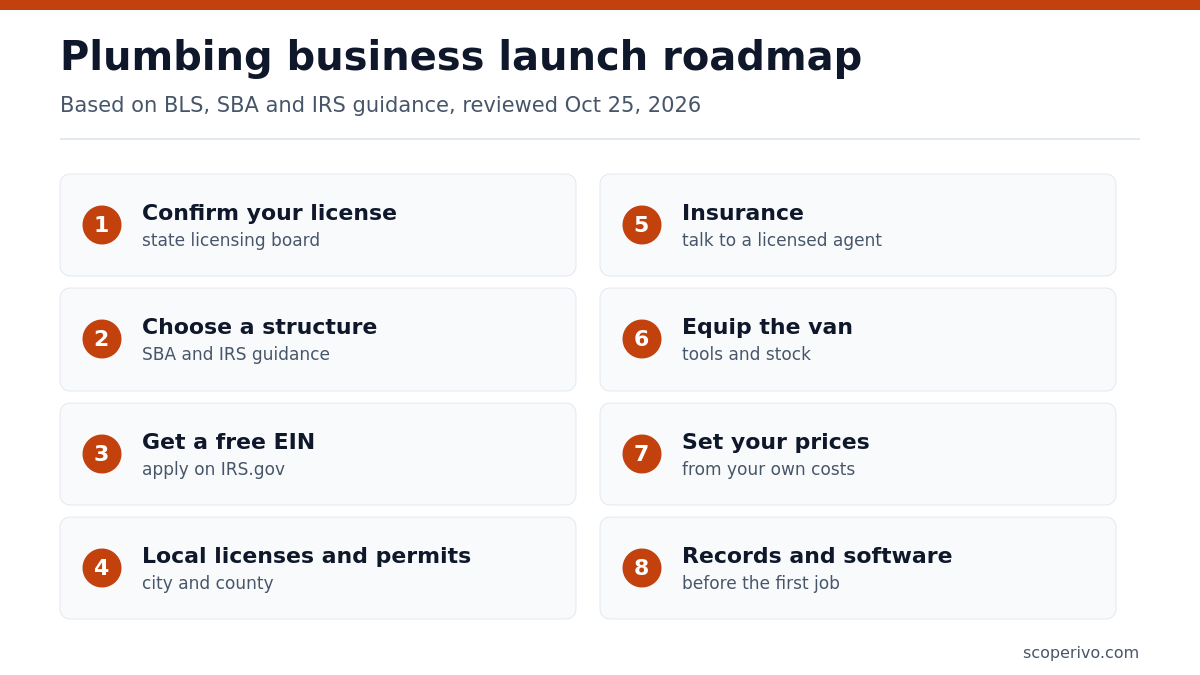
If you are working out how to start a plumbing business, the order is: hold the plumbing license your state requires for independent work, choose a business structure, get an EIN, obtain local licenses and permits, buy insurance, equip a van, set prices from your real costs, and put records and software in place before the first paid job.
Each step below explains what to do, why it matters and where to confirm the rules for your location. Requirements differ by state and city, so treat this as a roadmap and check the details with your state licensing board, the SBA and the IRS. We do not quote start-up cost figures, because van, tools and insurance costs vary too much by market to give a useful number.
How to start a plumbing business: the steps at a glance
- Confirm the license you need to work and contract independently.
- Choose a business structure and register it with your state if required.
- Get a free EIN from the IRS and open a business bank account.
- Apply for local business licenses and permits.
- Buy the insurance your state and clients require, plus the coverage you choose.
- Equip a van with tools, safety gear and a starter parts stock.
- Set your hourly and flat-rate prices from your own costs.
- Set up bookkeeping and a recordkeeping routine.
- Pick a simple software stack for scheduling, quotes and invoices.
- Win your first customers and track where they come from.
The order matters. For example, the IRS asks you to form an LLC or corporation with your state before you apply for an EIN, and local permit offices may ask for your license number and proof of insurance, so check their requirements before you apply.
Step 1: Get the right plumbing license first
Anyone researching how to start a plumbing business runs into licensing first, because it is the gate for everything else. According to the BLS, most states and some localities require plumbers to be licensed. The exact rules, exam content and experience hours are set by your state, and sometimes by your city or county, so the first call should be to your state plumbing or contractor licensing board.
Apprenticeship and journey-level status
Most plumbers learn through a 4- or 5-year apprenticeship that combines paid work with technical instruction. The BLS says apprentices typically receive 2,000 hours of paid on-the-job training, as well as some technical instruction, each year. After completing an apprenticeship and passing the licensing exam, a plumber becomes a journey-level worker who can perform tasks independently.
Master plumber and contractor licenses
Working for yourself often needs more than a journey card. The BLS notes that some states require master plumber status in order to obtain a plumbing contractor’s license, and that starting your own business as an independent contractor may require additional licensing. Ask your board three questions: which license lets you pull permits, which lets you hire other plumbers, and whether gas line work needs a separate endorsement.
The BLS also notes that licensing requirements commonly ask for 2 to 5 years of experience and an exam before plumbers work independently. Plan your timeline around that requirement; it is the one step you cannot rush.
Step 2: Choose a business structure
Structure is the second big decision in how to start a plumbing business, because it affects taxes, paperwork and personal liability. The IRS explains that your form of business determines which income tax return form you have to file, and it points readers to the SBA for the comparison. Talk to an accountant or attorney before you decide; this section only outlines the choices.
Sole proprietorship
A sole proprietorship is the default if you start working without registering another structure. It is simple, but the SBA warns that you can be held personally liable for the debts and obligations of the business. For a trade where a single leak can damage a home, that risk is worth discussing with a professional.
LLC and other options
According to the SBA, LLCs protect you from personal liability in most instances, so personal assets such as your vehicle, house and savings are generally kept separate if the business is sued. LLC members are considered self-employed and pay self-employment tax. Partnerships and corporations are also options, especially if you start with a partner. Whichever you choose, register it with your state before applying for an EIN.
Step 3: Get an EIN and open a business bank account
Getting an EIN is one of the quickest tasks in how to start a plumbing business. An Employer Identification Number is your business’s federal tax ID. The IRS offers an online application, and you never have to pay a fee for an EIN, so ignore websites that charge for one. The IRS lists hiring employees and operating a partnership or corporation among the reasons you need an EIN.
Once you have the EIN, open a business checking account and route every job payment and business expense through it. Keeping business and personal money apart makes bookkeeping far easier and supports any liability protection your structure offers. It also gives you a clean account to connect to accounting software later.
Step 4: Licenses, permits and insurance
Beyond your trade license, anyone working out how to start a plumbing business will usually need general business licenses too. The SBA says that the licenses and permits you need from the state, county, or city will depend on your business activities and business location, and it lists plumbing among activities commonly regulated at the local level. Review the SBA licenses and permits guide and then check your city and county websites.
Local licenses and permits
- A general business license or tax registration from your city or county.
- Contractor registration, if your state separates it from the trade license.
- Job permits for installs and alterations, usually pulled per project by the licensed plumber.
- Home-based business or zoning approval if you run the business from home.
- A renewal calendar, because the SBA notes that some licenses and permits expire after a set period.
Insurance to discuss with a licensed agent
Insurance needs depend on your state, your clients and whether you hire. The SBA says the federal government requires every business with employees to carry workers’ compensation, unemployment and disability insurance, and that some states require more. Policies to ask an agent about include general liability (on the SBA list of common business insurance), commercial auto for the van, tool or equipment coverage, and workers’ compensation once you have staff. Many contractors also look at a business owner’s policy, which bundles common coverages. Ask an agent to explain limits and exclusions in writing.
Step 5: Tools, van and starter stock
Your van is your shop, and equipping it is one of the most practical parts of how to start a plumbing business. Start with the tools you already own and buy additions as real jobs demand them, rather than equipping for every possible call on day one. A practical starting kit covers these groups:
- Hand tools: pipe wrenches, basin wrench, tubing cutters, adjustable wrenches, files and a quality tool bag.
- Power tools: a cordless drill and driver, reciprocating saw, press tool if your market uses press fittings, and spare batteries.
- Drain tools: hand augers and a drum machine sized for the drain work you plan to offer.
- Diagnostic tools: a moisture meter and, as work grows, an inspection camera.
- Safety gear: eye and hearing protection, gloves, knee pads, a first-aid kit and a fire extinguisher.
- Starter stock: common supply lines, shutoff valves, fittings, wax rings, cartridges and fasteners, organized in labeled bins.
Shelving and bins pay for themselves because every minute spent searching the van is unbilled. Put your business name, phone number and license number on the vehicle if your state or city requires it, and because a clean, marked van is also advertising.
Step 6: Price your services from your own numbers
Pricing is where many guides on how to start a plumbing business stop short. Many new owners copy a competitor’s rate and discover months later that it never covered their costs. Build your rate from the bottom up. The figures below are an illustrative example only; replace every number with your own.
Worked example: finding an hourly rate
- Weekly owner pay target: 1200 dollars.
- Weekly van payment, fuel and vehicle insurance: 350 dollars.
- Weekly tools, phone, software and office costs: 150 dollars.
- Weekly set-aside for licenses, accounting and slow seasons: 100 dollars.
- Total weekly cost: 1200 + 350 + 150 + 100 = 1800 dollars.
- Billable hours: you may work 40 hours, but driving, quoting and parts runs leave about 25 billable hours.
- Break-even rate: 1800 / 25 = 72 dollars per billable hour.
- Add a 20 percent profit margin: 72 / 0.80 = 90 dollars per billable hour.
Turning the rate into a flat price
Customers often prefer one price for a defined task. Using the example rate, a faucet replacement that takes 1.5 hours is 1.5 x 90 = 135 dollars of labor. If the faucet and supply lines cost you 85 dollars and you price parts at 110 dollars, the flat price is 135 + 110 = 245 dollars. Write each task down this way and you have the start of a pricebook. Your plumbing invoice template should show the same task name the customer approved.
Step 7: Keep records the IRS way
Recordkeeping is the least exciting part of how to start a plumbing business, yet good records protect you at tax time and tell you whether the business is working. The IRS says you may choose any recordkeeping system suited to your business that clearly shows your income and expenses. For a plumbing business that usually means invoices, receipts for parts and fuel, mileage logs, bank statements and payroll records once you hire.
How long to keep them depends on the record. The IRS guidance on how long to keep records starts from a basic rule: the basic period is 3 years, but some situations require 6 or 7 years, or keeping records indefinitely. It also says to keep employment tax records for at least 4 years after the date that the tax becomes due or is paid, whichever is later. Ask your accountant which rules fit your situation, and set up a monthly routine to file receipts rather than a year-end scramble.
If you plan to use QuickBooks, our guide to QuickBooks for contractors walks through job-based setup.
Step 8: Choose a simple software stack
If you are planning how to start a plumbing business on a tight budget, software is an area where small, cheap tools work well. You do not need an enterprise system to start. A lean stack for a one-truck plumbing business covers four jobs:
- Scheduling, quotes and invoices: a field service app or a simple estimate-and-invoice app.
- Payments: card and bank payments built into that app, so customers can pay on site.
- Accounting: bookkeeping software connected to your business bank account.
- Phone coverage: voicemail-to-text at minimum, or an answering service for after-hours emergencies.
Our overview of field service software for small business compares the main options, and a printed or digital work order template keeps job details consistent if you start on paper. Because plumbing calls often come after hours, read our guide to the answering service for contractors before you decide how to cover the phone.
Step 9: Find your first customers
The final step in how to start a plumbing business is the one that pays the bills. Early work usually comes from people who already know you. Then it shifts to search and reviews. Focus on a few channels and track every lead source from the first call.
Low-cost channels that work for new plumbers
- Tell past employers, general contractors and property managers that you are available for overflow and service calls.
- Create a free business profile on major map and search listings with accurate hours and service area.
- Ask every satisfied customer for a review the same day, with a direct link.
- Leave a branded magnet or sticker on water heaters and under sinks so the next call comes to you.
- Offer a simple maintenance visit, such as a water heater flush, to turn one-time callers into repeat customers.
Hiring your first plumber or helper
Hiring is usually the step after you have learned how to start a plumbing business and kept one truck busy for a few months. The trigger is simple: you are turning down work or working evenings every week just to keep up. Before you post a job, line up the basics so the first hire goes smoothly.
What changes when you have employees
- You need an EIN if you were operating without one, because the IRS lists hiring employees as a reason to have an EIN.
- Workers’ compensation, unemployment and disability coverage become requirements, as described in Step 4.
- Payroll records and employment tax filings start, with their own retention rules.
- Your state licensing board may set ratios or supervision rules for apprentices working under a licensed plumber.
Many owners start with an apprentice or helper rather than a second licensed plumber. Apprenticeship programs are sponsored by unions, trade associations and businesses, so ask your state apprenticeship agency whether your company can register as a sponsor.
Mistakes that slow down new plumbing businesses
These are the errors that most often cost new owners time or money in the first year. Each one is avoidable with a little planning.
- Starting paid work before confirming that your license covers independent contracting in your city.
- Mixing personal and business money in one account, which makes bookkeeping and taxes harder.
- Pricing from a competitor’s rate instead of your own costs and billable hours.
- Buying every tool up front instead of adding equipment as jobs require it.
- Missing renewal dates for licenses, permits or insurance because nobody tracks them.
- Not recording where each customer came from, so you cannot tell which marketing works.
- Letting after-hours calls go to a full voicemail box in a trade built on emergencies.
If you avoid these, the rest of the plan for how to start a plumbing business becomes a matter of steady execution rather than repairs to the foundations.
First-year checklist for a new plumbing business
Copy this checklist into your notes and tick items off as you go. It complements the step-by-step guide on how to start a plumbing business above and keeps the ongoing tasks visible after launch.
BEFORE THE FIRST JOB
[ ] Plumbing license that allows independent or contractor work: [license number]
[ ] Business structure chosen and registered with the state (if required)
[ ] EIN received from IRS.gov (free)
[ ] Business bank account opened
[ ] City / county business license: [number]   Renewal date: [date]
[ ] Insurance bound: general liability, commercial auto, tools; workers' comp if hiring
[ ] Van shelved, labeled and stocked
[ ] Hourly rate and first 20 flat-rate prices written down
[ ] Quote, invoice and payment tool set up
[ ] Bookkeeping software connected to bank account

FIRST 90 DAYS
[ ] Business listing live on map and search sites
[ ] Review request sent after every job
[ ] Lead source recorded for every call
[ ] Receipts filed weekly

EVERY QUARTER
[ ] Compare actual costs with your pricing assumptions; adjust rates
[ ] Check license, permit and insurance renewal dates
[ ] Review which lead sources produced paying jobs
[ ] Meet your accountant about estimated taxes

END OF YEAR ONE
[ ] Review structure and insurance with your advisers
[ ] Decide whether to hire an apprentice or helper
[ ] Launch or expand maintenance plans for repeat customers
Sources and method
We wrote this guide on how to start a plumbing business on October 25, 2026 using the BLS Occupational Outlook Handbook profile for plumbers, the SBA pages on choosing a business structure and applying for licenses and permits, and IRS pages on business structures, EINs, recordkeeping and record retention. We did not use third-party cost surveys. Rules change and vary by location, so confirm requirements with your state licensing board, local permit office and a qualified accountant or attorney.
Frequently asked questions
Do I need a license to start a plumbing business?
In most places, yes. The BLS says most states and some localities require plumbers to be licensed, and some states require master plumber status for a plumbing contractor’s license. Requirements vary, so contact your state licensing board to confirm which license lets you work independently, pull permits and hire other plumbers.
How long does it take to start a plumbing business?
Learning how to start a plumbing business on paper is quicker than qualifying for it. The paperwork, such as registering a structure, getting an EIN and applying for local licenses, can often be done in weeks. The longer part is licensing: plumbers usually complete a multi-year apprenticeship and need several years of experience before they can sit for the exams that allow independent work in many states.
Should a new plumbing business be an LLC?
An LLC is a common option because the SBA notes it protects personal assets from business liability in most instances. A sole proprietorship is simpler but leaves you personally liable. The right choice depends on your state, taxes and risk, so discuss it with an accountant or attorney before registering.
Is an EIN free for a plumbing business?
Yes. The IRS issues EINs for free through its online application, and it warns that you never have to pay a fee for an EIN. If you are forming an LLC or corporation, register it with your state first, then apply for the EIN so the application is not delayed.
What insurance does a plumbing business need?
It depends on your state and whether you hire. The SBA says businesses with employees must carry workers’ compensation, unemployment and disability insurance under federal rules, and some states add more. Most plumbing businesses also consider general liability, commercial auto and tool coverage. A licensed agent can recommend limits for your work.
How should I price plumbing jobs when I start?
Work out your weekly costs including your own pay, divide by realistic billable hours to find a break-even rate, then add a profit margin. Convert common tasks into flat prices using that rate plus parts. Review your numbers every quarter, because new businesses often underestimate drive time and slow weeks.