Free HVAC Service Agreement Template and Maintenance Agreement: Word & PDF (2026)
Last updated October 16, 2026. This template is free to download with no sign-up. It is general information, not legal advice; have it reviewed for your state or country before use. ScopeRivo may earn a commission from some software links. Read our disclosure.
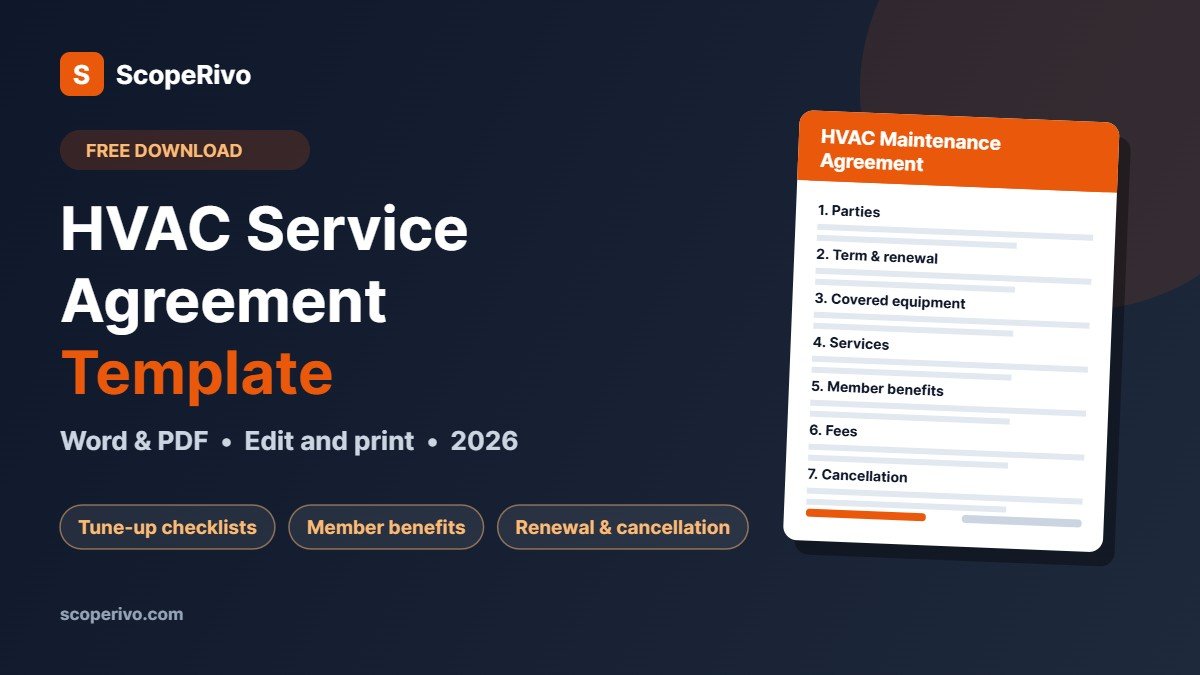
This free HVAC service agreement template gives you a ready-to-edit maintenance contract for your customers, covering the equipment, the tune-up visits, member benefits, fees, exclusions, cancellation and signatures. Download it in Word or PDF below, add your business details and prices, and you can start selling maintenance plans this week.
Short answer: a good HVAC service agreement lists the covered equipment, the number of visits per year (usually a spring cooling and a fall heating tune-up), what each visit includes, member benefits such as priority service and repair discounts, the annual or monthly fee, what is not covered, how renewal and cancellation work, and signatures from both parties. Our HVAC service agreement template includes all of these sections.
What is in this HVAC service agreement template
| Section | What it covers |
|---|---|
| 1. Parties | Your business and license details, the customer and the service address |
| 2. Term and renewal | 12-month term with a choice of automatic renewal or manual renewal |
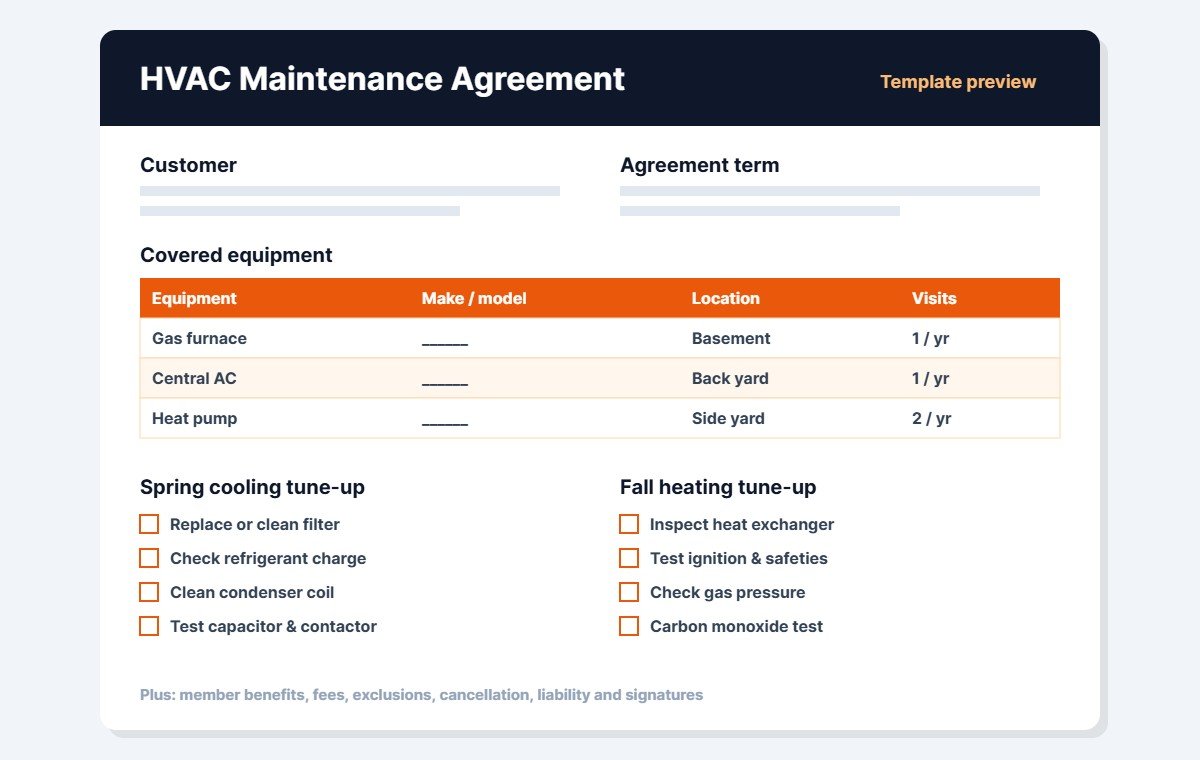
| 3. Covered equipment | Equipment type, make, model, serial number, install year and location |
| 4. Services included | Spring cooling and fall heating tune-ups with a checklist for each visit |
| 5. Member benefits | Priority scheduling, repair discount, diagnostic fee waiver and after-hours rate |
| 6. Fees and payment | Annual or monthly fee, extra equipment pricing and payment method |
| 7. What is not covered | Parts, repairs, ductwork, replacement and damage from outside causes |
| 8. Customer responsibilities | Access, clear outdoor units, filter changes and missed appointments |
| 9. Cancellation and refunds | Notice period and how unused prepaid fees are refunded |
| 10. Liability and warranty | Workmanship, manufacturer warranties and liability limits |
| 11. Signatures | Contractor and customer names, signatures and dates |
Placeholders in [square brackets] show where to add your own details, prices and policies. The Word version is fully editable; the PDF version is ready to print and fill in by hand.
Why every HVAC company needs a written service agreement
A verbal promise of “two tune-ups a year” leaves too much open to argument. A written HVAC service agreement sets expectations on both sides: the customer knows exactly what they are paying for, and your technicians know exactly what to deliver. It also gives you predictable recurring revenue before the busy season, a reason to visit every customer twice a year, and a record of the equipment in every home you serve. Starting from an HVAC maintenance agreement template saves hours of drafting and makes sure you do not forget a key clause.
HVAC service agreement vs maintenance agreement: is there a difference?
In everyday use, contractors use HVAC service agreement, HVAC maintenance agreement and HVAC maintenance contract to mean the same thing: a yearly plan where the customer pays for scheduled tune-ups and gets member benefits. Some companies use “service agreement” for broader plans that also cover certain repairs, and “maintenance agreement” for tune-up-only plans. Our HVAC maintenance agreement template is written as a tune-up plan with repair discounts, which is the most common setup for small residential companies.
How to fill out the HVAC service agreement template
- Add your business details. Business name, address, phone, email and license number in Section 1.
- Choose your renewal model. Delete the option you do not use in Section 2: automatic renewal or renewal by signature.
- List every covered unit. Record the make, model, serial number and install year for each system. This also feeds your CRM.
- Set the visit schedule. Most residential plans include two visits: cooling in spring and heating in fall. Edit the checklists to match what your technicians actually do.
- Define member benefits. Fill in your repair discount, diagnostic fee policy and after-hours rate.
- Set the price. Enter the annual fee or the monthly fee, plus the price for each additional piece of equipment.
- Review exclusions and cancellation. Make sure Sections 7 and 9 match your policy and local consumer law.
- Sign and file. Both parties sign. Keep a copy and schedule the first visit in your software.
What to include in each tune-up visit
The visit checklists are what customers are really paying for, so make them specific. These are typical items for a residential HVAC service agreement:
| Cooling tune-up (spring) | Heating tune-up (fall) |
|---|---|
| Inspect and clean the condenser coil | Inspect burners and the heat exchanger |
| Check refrigerant pressures and temperatures | Test ignition and safety controls |
| Test capacitors, contactor and motors | Check gas pressure on gas appliances |
| Clear and test the condensate drain | Inspect the flue and venting |
| Check thermostat calibration and operation | Test for carbon monoxide |
| Tighten electrical connections | Check blower operation and airflow |
| Replace a standard air filter | Replace a standard air filter |
Give the customer a short written report after each visit. It shows the value of the plan and creates a natural moment to quote repairs or a future replacement.
How to price an HVAC service agreement
Price your plan from your costs, not from a competitor’s flyer. A simple method:
- Estimate the time per visit, including travel, for example 1.5 hours.
- Multiply by your loaded labor cost (wages, taxes, vehicle and overhead per hour).
- Add materials, such as filters and cleaning supplies.
- Add the cost of benefits, such as the expected value of repair discounts and waived fees.
- Apply your target margin by dividing the total cost by one minus the margin.
| Item | Example |
|---|---|
| Two visits × 1.5 hours × $55 loaded labor cost | $165 |
| Filters and supplies | $20 |
| Expected cost of member discounts | $15 |
| Total cost per member per year | $200 |
| Price at a 40% margin ($200 ÷ 0.60) | About $333 per year |
If that price feels high for your market, reduce the visit time with better checklists, offer a single-visit plan, or keep the margin lower and treat the plan as a way to win repair and replacement work. Our guide to HVAC estimating software explains the difference between markup and margin in more detail.
Automatic renewal and cancellation: check your local rules
Automatic renewal makes maintenance agreements far more profitable, but many US states have automatic renewal laws that require clear disclosure, customer consent and an easy way to cancel. Consumer protection rules in the UK, Canada and Australia also cover subscription-style contracts. The US Federal Trade Commission’s guidance on negative option and automatic renewal offers is a useful starting point. Before you use an auto-renewing HVAC maintenance contract, check your state or country rules and have the cancellation clause reviewed.
- State the renewal terms clearly next to the price.
- Get explicit consent to automatic renewal, for example a separate checkbox or initials.
- Send a reminder before each renewal date.
- Make cancellation as easy as signing up.
Adapting the HVAC service agreement template for different customers
Single-system homes
The template works as written for a home with one furnace and one air conditioner or heat pump. List both units in Section 3 and keep the two-visit schedule.
Multi-system homes
Larger homes often have two or more systems. Price each additional system as an add-on in Section 6, and make sure each unit appears in the equipment table so there is no confusion about what is covered.
Landlords and property managers
For rental properties, add every service address, name who approves repairs, and state how you will access each unit. Property managers usually want one HVAC maintenance contract covering several addresses, with one invoice.
Light commercial customers
Small offices and shops often need quarterly visits, filter changes on a set schedule and faster response times. Use the HVAC service agreement template as a starting point, but add response-time commitments, after-hours coverage and insurance requirements.
Member benefit ideas for your HVAC maintenance agreement
| Benefit | Why customers value it | Cost to you |
|---|---|---|
| Priority scheduling | Faster help in a heat wave or cold snap | Low; scheduling order only |
| 10% to 20% repair discount | Lower repair bills | Reduces repair margin |
| Waived diagnostic or trip fee | No charge just to look at the problem | Lost fee revenue |
| No overtime charge | Same price nights and weekends | Higher labor cost on call-outs |
| Extended labor warranty on repairs | Peace of mind | Occasional warranty callbacks |
| Transferable plan | Adds value when selling the home | Minimal |
Pick three or four benefits you can deliver every time. A short, reliable list sells better than a long list your team cannot keep up with in the busy season.
Presenting the agreement to customers
Technicians sell most maintenance agreements, so give them a simple way to explain the plan. A short script works well:
“Today’s repair was $[amount]. Members on our maintenance plan get two tune-ups a year, priority booking and [15]% off repairs like this one. For most homes that is $[price] a year, or $[monthly] a month. Would you like me to set that up so your next tune-up is already booked?”
Keep printed copies of the HVAC service agreement template in every van, or send the Word version for e-signature, so the customer can sign while the technician is still on site.
What to do at renewal time
- Send a reminder 30 days before the end date, with the renewal price and what the customer received this year.
- Summarize the value, for example visits completed, discounts used and any issues caught early.
- Confirm the equipment list in case the customer replaced or added a system.
- Update the price if your costs changed, with clear notice.
- Book the next visit as soon as the plan renews.
Renewal rate is the most important number in a maintenance program. A member who renews for several years is worth far more than the first year’s fee suggests.
How to sell more HVAC service agreements
- Offer it on every call. The best time is right after a repair, when the customer has just seen the cost of a breakdown.
- Show the savings. Compare the plan price with the cost of two standalone tune-ups plus the repair discount.
- Offer monthly payments. A small monthly amount is easier to accept than one annual payment.
- Make renewal automatic, with proper consent and reminders.
- Track members in your CRM so technicians know who is and is not on a plan before they arrive.
A CRM that tracks equipment, visits and renewals makes maintenance agreements far easier to run at scale. We compare the options in our guide to the best CRM for HVAC companies.
Should you use software instead of a paper agreement?
A Word or PDF HVAC service agreement template is perfect for getting started. Once you have more than a few dozen members, field service software saves time by scheduling tune-ups automatically, charging renewals by card and reminding customers before each visit.
| Template (Word or PDF) | Field service software | |
|---|---|---|
| Cost | Free | Monthly subscription |
| Signing | Print or e-sign tool | Built-in e-signature on many plans |
| Visit scheduling | Manual | Automatic recurring visits |
| Renewals and payments | Manual | Automatic card billing on many plans |
| Best for | First 20 to 50 members | Growing membership programs |
Housecall Pro includes recurring service plans on its Max plan, and FieldEdge and ServiceTitan are built around memberships. See our guide to field service software for small business for pricing.
The visit report: what to give customers after each tune-up
A one-page report after every visit is what makes members feel the plan is worth renewing. Include:
- Date, technician name and the equipment serviced.
- Each checklist item marked as passed, adjusted or needs attention.
- Readings such as refrigerant pressures, temperature split and carbon monoxide levels.
- Photos of any problems found.
- Recommended repairs with prices, clearly marked as optional.
- The date of the next scheduled visit.
Most field service apps can generate this report automatically from a checklist. If you are working from the HVAC service agreement template on paper, a simple printed checklist does the same job.
Record keeping for HVAC maintenance agreements
Keep the signed agreement, every visit report and any renewal or cancellation notice for each customer. Good records help you resolve disputes, support warranty claims and show what was done if equipment fails later. Store copies digitally, linked to the customer and equipment record, so any technician can see the history before a visit.
If you run your plans from the free HVAC service agreement template, create a simple spreadsheet listing each member, their start date, renewal date, visits completed and fee status. Review it every month so no tune-up or renewal is missed.
Common mistakes in HVAC service agreements
- Vague visit descriptions. “Annual maintenance” invites disputes. List what each visit includes.
- No equipment list. Without it, customers may expect you to cover every unit in the house.
- Unclear exclusions. State plainly that parts, repairs and replacement are not included unless you choose to cover them.
- Hidden auto-renewal. Unclear renewal terms can break consumer law and damage trust.
- Pricing below cost. Work out your cost per visit before you set the price.
- No follow-up on visits. If visits are not scheduled automatically, members miss tune-ups and do not renew.
Download the free HVAC service agreement template
Pick the format that suits how you work. Both are free, with no sign-up, and you can edit them for your business.
- Word (.docx): fully editable in Microsoft Word or Google Docs.
- PDF: printable two-page HVAC maintenance agreement template to fill in by hand.
Need to bill for repairs outside the plan? Use our free contractor invoice template.
Related guides
- HVAC Maintenance Checklist: Free Printable for Homes and Commercial Units (2026)
- Free Contractor Proposal Template That Wins More Jobs (2026)
HVAC service agreement template FAQ
Is this HVAC service agreement template free?
Yes. The Word and PDF versions are free to download and edit for your business, with no email sign-up.
What should an HVAC maintenance agreement include?
The parties, term and renewal, covered equipment, the visits and checklists, member benefits, fees, exclusions, customer responsibilities, cancellation terms, liability and signatures.
How much should I charge for an HVAC service agreement?
Work out your cost per member, including visit time, labor cost, supplies and discounts, then add your target margin. Prices vary widely by market, so base yours on your own costs rather than a national average.
Can I use this template for commercial HVAC customers?
It is written for residential customers. Commercial agreements usually need more detail on response times, equipment schedules, after-hours coverage and insurance, so adapt it or use a commercial contract.
Is an HVAC service agreement legally binding?
A signed agreement is generally a binding contract, but rules on consumer contracts, automatic renewal and cancellation vary by location. Have your final version reviewed by a local attorney.
How many visits should an HVAC maintenance agreement include?
Most residential plans include two visits a year: a cooling tune-up in spring and a heating tune-up in fall. Heat pump systems that run all year benefit from both visits. Commercial plans often include quarterly visits.
Should HVAC service agreements renew automatically?
Automatic renewal improves retention, but you must follow local automatic renewal and consumer laws, which usually require clear disclosure, consent and an easy way to cancel.
Can I open the template in Google Docs?
Yes. Upload the Word file to Google Drive and open it with Google Docs.