Free Construction Estimate Template + How to Price a Job (2026)
Last updated October 25, 2026. This guide was compiled from the U.S. Bureau of Labor Statistics, IRS and SBA pages linked below, checked on October 25, 2026, plus a worked pricing example with illustrative numbers. ScopeRivo may earn a commission from some links; read our affiliate disclosure.
A construction estimate template is a fixed layout for pricing a job: your company and client details, a written scope, line items grouped by materials, labor, equipment, subcontractors and permits, then overhead, contingency and profit, followed by allowances, exclusions, payment terms, an expiry date and signatures. Copy the free version below and fill it from your own costs.
The rest of this guide explains what goes on each line, walks through a full priced example, and clears up the markup vs margin mix-up that quietly shrinks profit on many small jobs. If you mostly need a document to collect payment after the work is done, our contractor invoice template is the better starting point.
Download the free construction estimate template
Excel (.xlsx) with a blank estimate sheet and the worked example from this guide. Overhead, contingency, profit and totals calculate automatically. No sign-up needed.
What a construction estimate template has to do
An estimate does two jobs at once. For the client, it answers “what am I getting and what will it cost?” For you, it is the costing worksheet that proves the price covers every dollar you will spend plus a fair profit. A good construction estimate template forces both answers onto one page so nothing gets priced from memory.
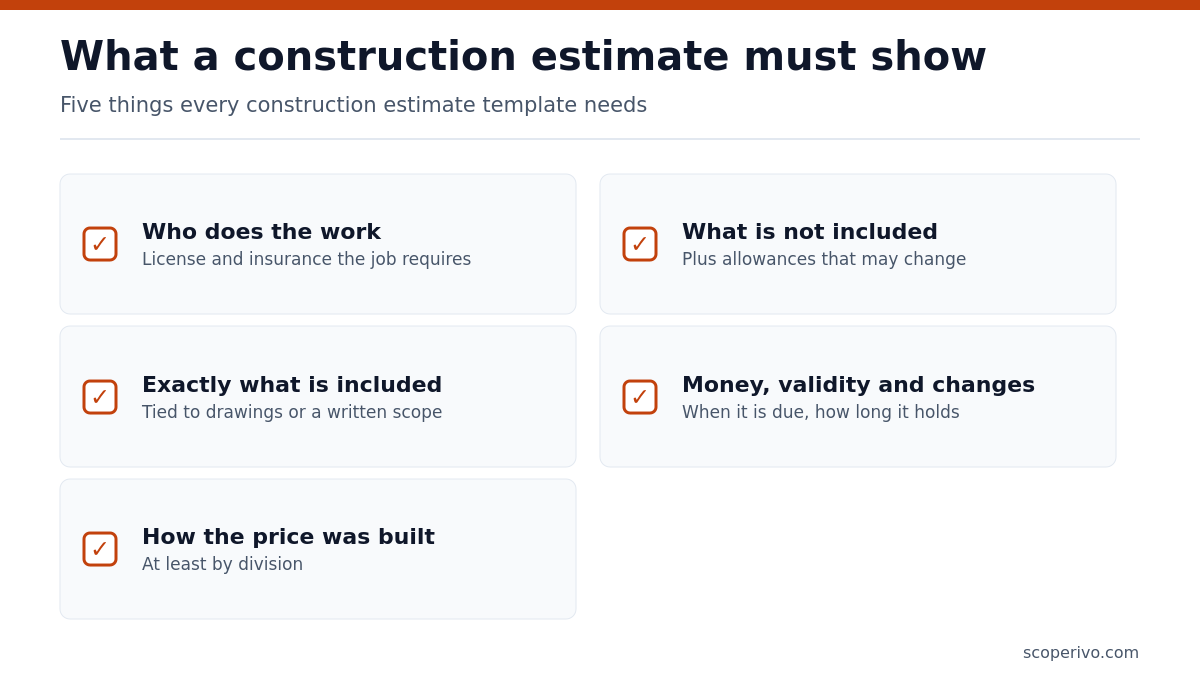
At a minimum, the document should let a stranger read it and know:
- Who is doing the work, and whether they hold the license and insurance the job requires.
- Exactly what work is included, tied to drawings or a written scope.
- How the price was built, at least at the division level (materials, labor, equipment, subs, permits).
- What is not included, and which items are allowances that may change.
- When money is due, how long the price holds, and how changes are handled.
Professional estimators work the same way. The Bureau of Labor Statistics describes cost estimators as people who identify factors affecting costs, such as production time, materials, and labor, and who maintain records of estimated and actual costs. A construction estimate template is the tool that makes that discipline repeatable for a small crew.
Free construction estimate template (copy and paste)
Paste this construction estimate template into a word processor, spreadsheet or your estimating app. The divisions run in the order costs usually hit a job, and the summary block keeps overhead, contingency and profit visible to you as separate lines. You can collapse those three into one “general conditions and fee” line on the client copy if you prefer not to show your markup.
CONSTRUCTION ESTIMATE
[Company name]   [Street address, city, state, ZIP]
Phone: [ ]   Email: [ ]   Website: [ ]
Contractor license no.: [number, where your state or city requires one]
Insurance: [general liability carrier] / [workers' comp carrier]

Estimate no.: [YYYY-###]      Date issued: [MM/DD/YYYY]
Prepared by: [name, title]    Valid through: [MM/DD/YYYY]

CLIENT AND PROJECT
Client name: [ ]              Phone: [ ]   Email: [ ]
Billing address: [ ]
Project address: [ ]
Project name: [e.g. Rear deck and stair replacement]
Drawings / specs used: [plan set name, revision, date]
Site visit date: [MM/DD/YYYY]  Planned start: [week of ...]
Estimated duration: [__] working days

SCOPE OF WORK
1. [Demolition and removal of ...]
2. [Install ... per drawing A-2]
3. [Finish ... to match existing]
Work is limited to the items listed. Anything not listed is excluded.

LINE ITEMS BY DIVISION
Div  Description              Qty    Unit    Unit cost   Line total
-------------------------------------------------------------------
A. MATERIALS
01   [Framing lumber]         [__]   [ea]    [amount]    [amount]
02   [Fasteners, hardware]    [__]   [lot]   [amount]    [amount]
03   [Finish materials]       [__]   [sq ft] [amount]    [amount]
     Materials subtotal                                  [amount]
B. LABOR
04   [Carpentry crew]         [__]   [hrs]   [rate]      [amount]
05   [General labor/cleanup]  [__]   [hrs]   [rate]      [amount]
     Labor subtotal                                      [amount]
C. EQUIPMENT
06   [Rental: auger, lift]    [__]   [days]  [amount]    [amount]
07   [Dumpster / haul-off]    [__]   [ea]    [amount]    [amount]
     Equipment subtotal                                  [amount]
D. SUBCONTRACTORS
08   [Electrical - per sub quote dated ...]              [amount]
09   [Other trade]                                       [amount]
     Subcontractor subtotal                              [amount]
E. PERMITS AND FEES
10   [Building permit - estimated, actual fee billed at cost] [amount]
11   [Inspection / engineering, if required]             [amount]
     Permits subtotal                                    [amount]

DIRECT COST TOTAL (A through E)                          [amount]
Overhead ([__] percent of direct cost)                   [amount]
Contingency ([__] percent of direct cost)                [amount]
Profit ([__] percent markup)                             [amount]
Sales tax, if it applies in your state                   [amount]
ESTIMATE TOTAL                                           [amount]

ALLOWANCES (client selections; adjusted up or down at actual cost)
- [Light fixtures]: [amount] allowance
- [Tile or decking upgrade]: [amount] allowance

EXCLUSIONS
- [Hidden damage, rot or code upgrades found after opening walls]
- [Landscaping repair, painting, utility relocation]
- [Anything not listed under Scope of Work]

PAYMENT TERMS
Deposit: [amount] due at signing
Progress payment: [amount] due at [milestone]
Final payment: [amount] due at completion and final walkthrough
Accepted methods: [check / ACH / card]   Late payments: [your terms]

CHANGES
Changes to scope, materials or schedule require a written change
order signed by both parties before the work is performed.

VALIDITY
Prices hold until the date above. Material prices may be
re-quoted after that date.

ACCEPTANCE
Client signature: _______________________  Date: ___________
Contractor signature: ___________________  Date: ___________
Keep the construction estimate template numbering even on small jobs. Consistent line numbers let you compare this estimate with the final job cost later, which is how your pricing improves over time.
How to fill in each section of the template
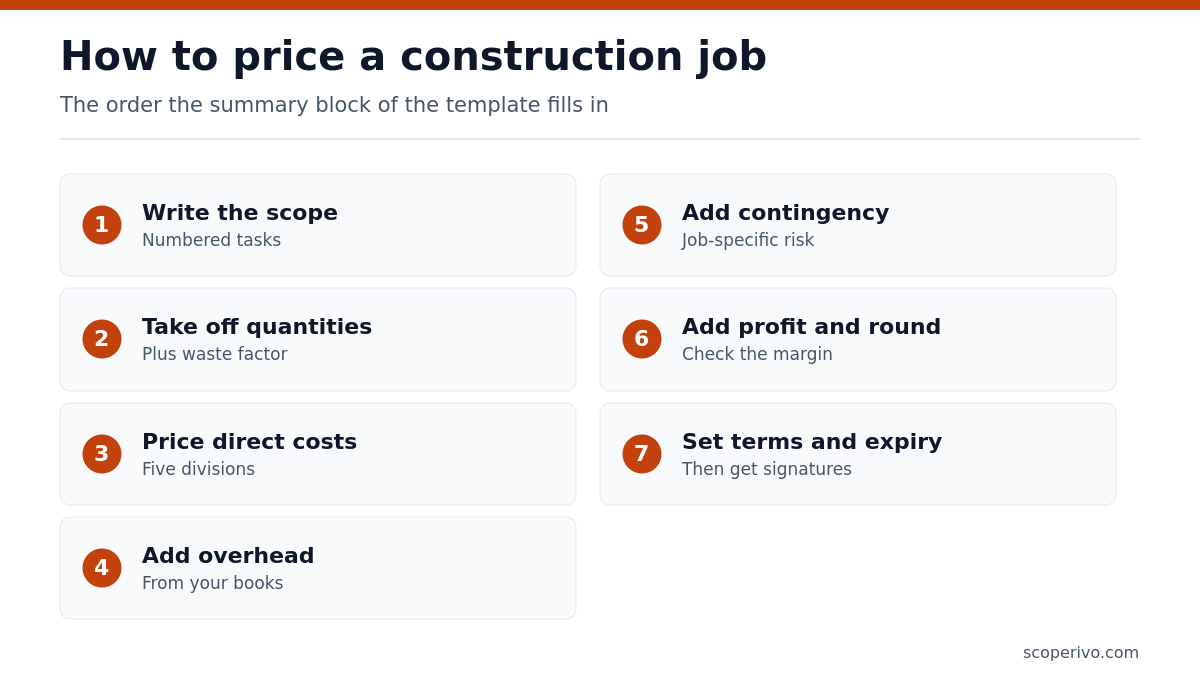
Work through the construction estimate template top to bottom. The order matters because the scope drives the quantities, the quantities drive the costs, and the costs drive the markup.
Header, client and project details
Give every estimate a unique number and an issue date. A year-plus-sequence format such as 2026-041 sorts cleanly and ties the estimate to the later invoice. List your license number where your state or city requires one; the SBA notes that construction is one of the business activities commonly regulated at the local level, so check your city or county building department as well as the state board. Add the drawing set and revision you priced from, which settles arguments when plans change after you send the number.
Scope of work
Write the scope as numbered, plain-language tasks: “Remove existing deck boards and railings, haul away” rather than “demo.” Finish the section with a sentence stating that anything not listed is excluded. That single line prevents more disputes than any other clause on the page.
Line items by division
Group costs into five divisions so you can see where the money goes:
- Materials: quantities from your takeoff, plus a waste factor you track from past jobs. Use current supplier quotes, not last year’s price list.
- Labor: hours by crew or trade multiplied by a loaded hourly rate that includes payroll taxes, workers’ comp and benefits, not just the wage.
- Equipment: rentals, fuel, delivery charges and the dumpster. Owned equipment can carry an hourly or daily charge so it pays for itself.
- Subcontractors: enter each sub’s written quote with its date. If a quote excludes something, carry that exclusion into yours.
- Permits and fees: permit, plan review, inspections and any engineering letters. Mark permit fees as estimated if the jurisdiction calculates them later.
Overhead, contingency and profit
Overhead is what it costs to keep the company open whether or not this job happens: office rent, trucks, insurance, software, phones and your own salary for non-billable time. Contingency is a reserve for known unknowns on this specific job. Profit is the return for taking the risk. Keep them on separate lines of your internal construction estimate template so you never trade one away by accident when a client pushes on price.
Allowances and exclusions
On a construction estimate template, an allowance is a placeholder amount for something the client has not picked yet, such as fixtures or flooring. State the amount and that it adjusts to actual cost. Exclusions list the things a reasonable client might assume are included but are not: hidden rot, code upgrades triggered by inspection, landscaping repair, painting, or utility work.
Payment terms, validity and signatures
Tie progress payments to visible milestones, not dates. Set a validity period short enough to protect you from material price swings, and say what happens when it lapses. Some states limit how large a deposit a contractor can request on home improvement work, so confirm the rule with your state licensing board before you fill in the deposit line. Finally, require signatures from both sides; an unsigned estimate is just a price list.
How to price a job: a worked example
Here is how the summary block of the construction estimate template fills in on a realistic small project. All figures are illustrative dollars chosen to keep the math easy to follow; they are not market prices, and your numbers will differ by region and trade.
Example project: replace a 320 square foot backyard deck with new framing, composite decking, a stair and two exterior lights.
Step 1: Add up direct costs
| Division | Basis | Amount (example) |
|---|---|---|
| Materials | Takeoff plus waste allowance, supplier quote | 6400 |
| Labor | 2 carpenters x 40 hours x 65 per hour loaded rate | 5200 |
| Equipment | Post-hole auger rental and one dumpster | 450 |
| Subcontractor | Electrician quote for two lights and a circuit | 900 |
| Permits and fees | Deck permit, estimated | 350 |
| Direct cost total | 13300 |
Step 2: Add overhead
Suppose your books show overhead running at about 10 percent of direct job costs over the last year. Ten percent of 13300 is 1330, which brings the running total to 14630. Use your own figure from your profit and loss statement; a guessed overhead rate is the most common reason an estimate looks fine but the year ends badly.
Step 3: Add contingency
This deck has an older ledger board that may hide rot. A 5 percent contingency on direct costs adds 665, for a running total of 15295. On a new build with clean plans you might carry less; on remodels with unknown conditions you might carry more.
Step 4: Add profit and round
Apply a 15 percent markup to 15295 and you get roughly 2294 in profit, for a total near 17589. Round to 17590 for the client copy. Now check the margin: 2294 divided by 17590 is about 13 percent. That gap between the 15 percent you added and the 13 percent you actually keep is the next section.
Markup vs margin, explained with plain numbers
Markup is profit measured against cost. Margin is profit measured against the selling price. Because the price is always bigger than the cost, the margin is always smaller than the markup. If you set a markup believing it is your margin, you keep less than you planned on every job.
- Markup: profit divided by cost. In the example, 2294 divided by 15295 is 15 percent.
- Margin: profit divided by price. In the example, 2294 divided by 17590 is about 13 percent.
- To hit a target margin: divide your cost by (1 minus the margin as a decimal). For a 20 percent margin on 15295, divide by 0.80 to get a price of about 19119.
| Markup you add | Margin you actually keep | Price on a job costing 10000 |
|---|---|---|
| 10 percent | about 9.1 percent | 11000 |
| 15 percent | about 13 percent | 11500 |
| 20 percent | about 16.7 percent | 12000 |
| 25 percent | 20 percent | 12500 |
| 33.3 percent | 25 percent | 13330 |
| 50 percent | about 33.3 percent | 15000 |
Pick one method and use it on every contractor estimate so your numbers stay comparable. Many accountants report results as margin, so pricing by target margin keeps your estimates speaking the same language as your financial statements.
Estimate vs quote vs bid vs proposal
People use these words loosely, but the estimate vs quote distinction matters when a client later says “you told me it would cost X.” Label your document correctly and say in writing whether the price is fixed.
| Document | What it promises | Typical use |
|---|---|---|
| Estimate | An informed approximation that may change if scope or conditions change | Early pricing, remodels with unknowns, time-and-materials work |
| Quote | A fixed price for a defined scope, usually for a set period | Small, well-defined jobs and repeat services |
| Bid | A price submitted to compete for a job, often against a set of plans and a deadline | Commercial and public work, general contractor invitations |
| Proposal | A sales document combining scope, approach, schedule, price options and terms | Larger residential projects and design-build sales |
In practice, a construction estimate template can become a quote simply by stating that the price is fixed until the validity date. When you need to sell the job with options, photos and a schedule, start from our contractor proposal template instead and attach the estimate as the pricing page.
What professional cost estimators do that small contractors can borrow
Cost estimating is a full-time occupation in larger firms. According to the BLS, the median annual wage for cost estimators was $78,740 in May 2025, and employment of cost estimators is projected to decline 3 percent from 2025 to 2035. You do not need a dedicated estimator to build their habits into your construction estimate template.
- Price the parts, not just the whole. Construction estimators may calculate the total cost of a whole project or of just one part, such as the foundation. Breaking work into assemblies makes errors easier to spot.
- Use your own history. The BLS notes that estimators check databases and their own records to compare the costs of similar projects. Save every finished job’s actual costs next to its estimate.
- Allow for what goes wrong. Their estimates include allowances for wasted material, bad weather, shipping delays, and other variables that can increase costs and lower profits. That is what the waste factor and contingency lines are for.
- Let software model the hard parts. On larger buildings, estimators use software to simulate the construction process and evaluate the price of design choices. For a small crew, that usually means takeoff and estimating tools rather than full building models.
The common thread is feedback. An estimate you never compare to actual cost cannot get better, which is why a construction estimate template should keep line numbers that match your job-costing categories.
Common mistakes when filling in a construction estimate template
Check every filled-in construction estimate template against this list before you send it.
- Pricing labor at the wage instead of the loaded rate. Payroll taxes, insurance and paid time off can add a large share on top of the hourly wage.
- Skipping mobilization and cleanup. Loading trucks, travel, daily cleanup and final haul-off all take paid hours.
- Treating overhead as profit. If the summary has one markup line, it is easy to forget that part of it pays the rent.
- Vague scope. “Repair siding as needed” invites an argument. Quantify it or make it an allowance.
- No expiry date. A client who signs four months later expects the old price.
- Copying sub quotes without their exclusions. If the electrician excludes patching, someone still has to patch.
- Confusing markup and margin. Covered above, and still the costliest mistake on this list.
Once the client signs, turn the scope into a field document so the crew builds what you priced. Our work order template is designed for that hand-off.
Keep your estimate and invoice records organized
A completed construction estimate template is also a business record. It supports the invoice, explains a change order, and shows how you arrived at income you later report. The IRS says good records help you monitor the progress of your business and prepare your financial statements, and that you may choose any recordkeeping system suited to your business that clearly shows your income and expenses.
The IRS page on what kind of records to keep explains that supporting documents include sales slips, paid bills, invoices, receipts, deposit slips, and canceled checks. File the signed estimate, any change orders, supplier receipts and the final invoice together under the estimate number. The same page also states that all requirements that apply to hard copy books and records also apply to electronic records, so scanned or app-stored copies must be just as complete and retrievable as paper.
If you have employees, the IRS recordkeeping page adds a separate rule: keep all records of employment taxes for at least four years. For anything about how long to keep a specific record or how to report it, check the IRS pages directly or ask a tax professional; this guide does not give tax advice.
When to move from a construction estimate template to software
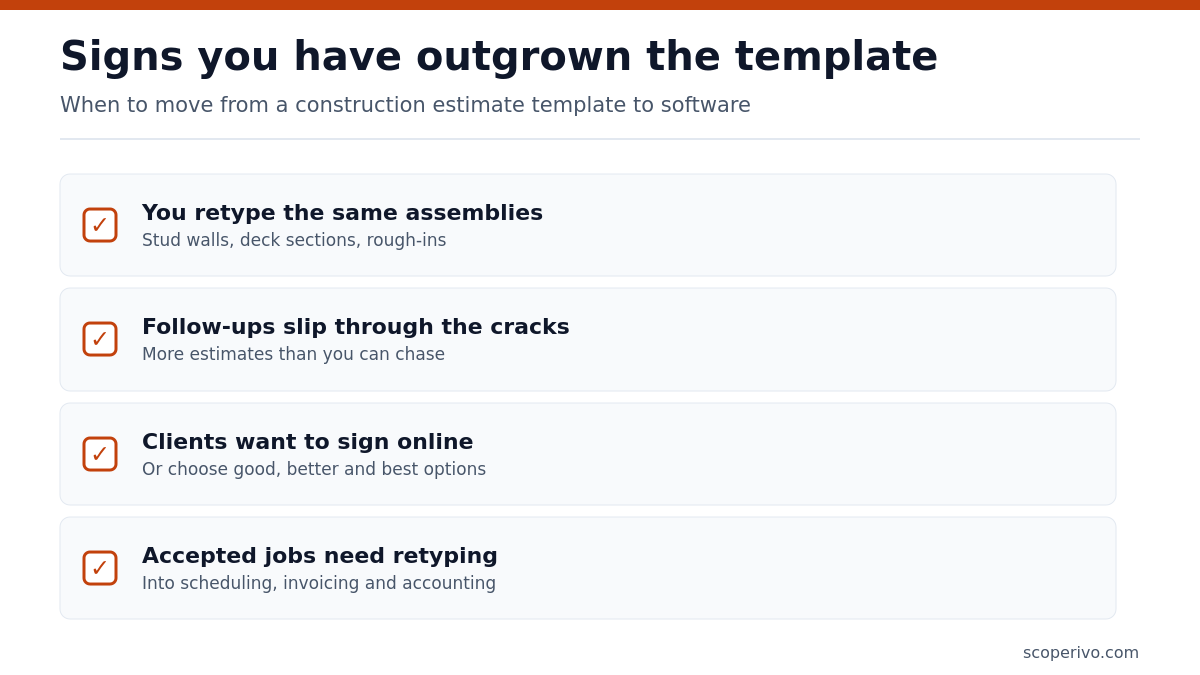
A copy-and-paste construction estimate template works well for a few estimates a week. It starts to cost you time and money when any of these become true:
- You retype the same assemblies (a stud wall, a standard deck section, a bathroom rough-in) on most jobs.
- You send more estimates than you can follow up on, and accepted jobs slip through the cracks.
- Clients expect to approve and sign online, or to pick between good, better and best options.
- You want each accepted estimate to flow into scheduling, invoicing and accounting without re-entry.
At that point, look at tools that store your cost items and convert an approved estimate into a job and an invoice. If your books already live in QuickBooks, read our guide to QuickBooks for contractors to see how estimates, job costing and invoicing connect there. Trades with very specific measurement needs often want a dedicated layout; see our painting estimate template for an example built around square footage and coats.
What to ask before you switch
- Can I build reusable assemblies with my own material and labor costs?
- Does the client copy hide internal markup while my copy shows it?
- Can an approved estimate become an invoice and a job record in one step?
- How do change orders attach to the original estimate?
How we compiled this guide
This construction estimate template guide was written for small US construction and remodeling businesses. Facts about professional cost estimators come from the Bureau of Labor Statistics Occupational Outlook Handbook page for cost estimators. Recordkeeping points come from the IRS recordkeeping and “what kind of records should I keep” pages, and the note on local regulation comes from the SBA page on licenses and permits. All sources were checked on October 25, 2026. The deck example uses illustrative numbers only and is not a price survey. ScopeRivo does not give legal or tax advice.
Frequently asked questions
What should a construction estimate template include?
It should include your company and license details, client and project information, a numbered scope of work, line items for materials, labor, equipment, subcontractors and permits, then overhead, contingency and profit. Close with allowances, exclusions, payment terms, a validity date and signature lines for both parties so the estimate can become a binding agreement once accepted.
How do I calculate a construction cost estimate?
Start with a takeoff of quantities from the plans or site visit, price each line from current supplier and subcontractor quotes, and add labor hours at a loaded hourly rate. Total those direct costs, then add overhead based on your own books, a job-specific contingency, and your profit. Round the final figure and set an expiry date.
What is the difference between markup and margin?
Markup is profit as a share of your cost; margin is profit as a share of the selling price. Adding a 25 percent markup to a job produces a 20 percent margin, not 25. To price for a target margin, divide your total cost by one minus the target margin expressed as a decimal.
Is an estimate legally binding?
An estimate is usually treated as an approximation, while a signed quote or contract with a fixed price is generally binding on both sides. The rules differ by state and by how the document is worded. Label it clearly, state whether the price is fixed, and check with your state licensing board or an attorney for your situation.
How much contingency should I add to a construction estimate?
There is no single correct figure. Base it on the risk in the specific job: new work with complete drawings needs less than a remodel with hidden conditions. Track how much contingency you actually used on finished jobs and adjust from that history rather than applying the same number to every project.
How long should an estimate stay valid?
Many contractors use 15 to 30 days, shorter when material prices are moving quickly. Pick a period you can honor without losing money, print the expiry date on your construction estimate template, and state that prices may be re-quoted after it passes. Re-check supplier pricing before you honor an estimate near its deadline.