How to Start a Lawn Care Business: Step-by-Step Guide (2026)
Last updated November 1, 2026. This guide is based on official SBA, IRS and BLS pages, checked on November 1, 2026, and is general information, not legal or tax advice. ScopeRivo may earn a commission from some links; read our affiliate disclosure.
Here is how to start a lawn care business in plain terms: pick a service area and a short list of services, write a one-page plan, choose a business structure and register it, get a free EIN, check state and local licenses (including pesticide rules), arrange insurance, buy only the equipment you need, and price each visit from your real costs.
Because it is November, this guide is built around a winter launch: roughly four months to finish the paperwork and line up customers before the first spring cut.
How to start a lawn care business: the 10 steps at a glance
- Choose your market and services.
- Write a lean business plan and a break-even number.
- Choose a business structure and register the business.
- Get an EIN and set up separate records.
- Check licenses, permits and pesticide rules.
- Arrange insurance before the first paid job.
- Buy or rent the core equipment.
- Set prices with a cost-based method.
- Use the winter to sell and prepare.
- Run a first-season checklist.
The steps overlap, and your state or city may add requirements, so confirm each legal step with the office named in that section.
Step 1: Choose your market and services
The first decision in how to start a lawn care business is demand, not equipment. The SBA’s plan your business guide suggests answering a short set of market questions before you spend money, including what potential customers pay for these alternatives and how many similar options are already available. For a lawn business, that means driving the neighborhoods you want to serve, noting which streets already have crews, and asking a few homeowners what they pay.
Mowing-only or full-service
A lawn mowing business that cuts, trims, edges and blows is the simplest model to launch, because you are not applying products. Full-service programs add fertilizer, weed control, aeration and cleanups. They earn more per property but bring licensing and recordkeeping duties, covered in Step 5, so many owners add treatments only once licensed.
Residential or commercial accounts
Residential yards are quick to sell but small. Commercial properties are larger, often bid yearly, and may ask for proof of insurance and written contracts. A residential route with a few small commercial accounts keeps cash flowing while you build references. A landscaping business that installs beds, plants and hardscape is a different model again, with larger jobs, deposits and longer estimates.
Step 2: Write a lean lawn care business plan
A one-page plan is the right size for most people working out how to start a lawn care business. The SBA describes two formats and notes that lean startup plans can take as little as one hour to make and are typically only one page. A traditional plan is longer and is the format lenders commonly request, so write the lean version first and expand it only if you apply for a loan.
Copy this outline and fill in the brackets. It follows the SBA lean plan elements, adapted to a lawn route, and is a practical first task for anyone deciding how to start a lawn care business.
LAWN CARE BUSINESS PLAN (ONE PAGE)
Business name: [name]            Service area: [ZIP codes or neighborhoods]
Value proposition: [why customers pick you, e.g. same day every week, photo after each visit]
Customer segments: [homeowners, small offices, HOAs]
Services, season 1: [mowing, trimming, edging, spring cleanup, leaf cleanup]
Channels: [door hangers, neighborhood groups, referrals, Google Business Profile]
Key resources: [truck, trailer, mower, trimmer, blower, phone app]
Key partnerships: [equipment dealer, repair shop, material supplier]
Cost structure: fixed per month [amount]; variable per visit [amount]
Revenue streams: [per-visit mowing, seasonal agreements, cleanups]
Break-even: [fixed costs per month] / ([price per visit] - [variable cost per visit]) = [visits per month]
Season goal: [number] weekly customers by [date]
Find your break-even number
The break-even line in the template comes straight from the SBA formula: break-even point (units) = fixed costs ÷ (sales price per unit – variable cost per unit). For a lawn business, a unit is one visit. Fixed costs are things you pay whether or not you mow, such as insurance, the phone plan and equipment loan payments; variable costs rise with each visit, mainly fuel, trimmer line, blade wear and helper wages.
The SBA also suggests you throw a little extra, say 10%, into your break-even analysis to cover miscellaneous expenses you can’t predict. On a lawn route that cushion covers surprises such as a broken spindle in July or a week of rain that pushes visits back.
Finish the plan by listing startup costs in two groups, one-time and monthly. The SBA suggests you count at least one year of monthly expenses, which shows how many weekly customers you need before the business pays you.
Step 3: Choose a structure and register the business
Picking a structure is the first legal decision in how to start a lawn care business, because it affects taxes, paperwork and personal liability. The SBA’s business structure guide explains that you’re automatically considered to be a sole proprietorship if you do business activities but don’t register as any other kind of business. The IRS adds that your form of business determines which income tax return form you have to file.
Sole proprietorship or LLC
- Sole proprietorship: the simplest start, but the SBA notes that your business assets and liabilities are not separate from your personal assets and liabilities.
- LLC: the SBA says LLCs can be a good choice for medium- or higher-risk businesses and for owners with significant personal assets they want protected. Members are still considered self-employed for tax purposes.
Lawn work involves moving blades, thrown debris and trailers on public roads, so weigh liability protection seriously. Which structure fits you is a legal and tax decision; the SBA points to business counselors, attorneys and accountants for help.
Registration costs depend on where you live. According to the SBA, in most cases the total cost to register your business will be less than $300, but fees vary depending on your state and business structure. If you trade under a name other than your own, you may also need to register a DBA with your state, county or city.
If you plan to run the business from home and park a trailer in the driveway, check zoning before you buy equipment. The SBA notes that zoning ordinances can still apply even to home-based businesses, and local rules may limit commercial vehicles, equipment storage or signage on residential lots.
Step 4: Get an EIN and set up your records
An Employer Identification Number is your business’s federal tax ID and a standard step in how to start a lawn care business. The IRS states plainly: You never have to pay a fee for an EIN, so avoid websites that charge for one. The IRS lists hiring employees and operating a partnership or corporation among the reasons you generally need an EIN, and the SBA notes you need one to open a bank account and apply for business licenses and permits.
Order matters here. The IRS says that if you are creating a corporation or LLC, form your entity through the secretary of state before you apply for an EIN; otherwise the application may be delayed. Print the EIN confirmation letter and keep it with your formation documents.
Recordkeeping from day one
The IRS says you may choose any recordkeeping system suited to your business that clearly shows your income and expenses. For a lawn route, that means every invoice, fuel receipt, equipment purchase and repair bill goes into one system tied to a separate business bank account. If you hire a helper next spring, note the IRS rule to keep all records of employment taxes for at least four years.
A simple invoice habit makes this easier. Our contractor invoice template shows the fields to include, and our guide to QuickBooks for contractors explains how to connect invoices to your books if you use accounting software.
Step 5: Check licenses, permits and pesticide rules
Licensing is the part of how to start a lawn care business that varies most by location, and there is no single national lawn care license. The SBA explains that local governments determine registration, licensing, and permitting requirements, so start with your city or county website and ask what a lawn service business needs. Common items include a general business license, a home occupation permit if you work from home, and state sales tax registration if your state taxes lawn services.
Chemical work is where rules get stricter. According to the BLS, most states require licensing for workers who apply pesticides, and licensing for workers who handle fertilizers varies by state. The BLS adds that getting a license usually involves passing a test on the proper use and disposal of insecticides, herbicides, and fungicides. If you plan to apply weed control or insect treatments for paying customers, contact the state agency that licenses pesticide applicators before you sell those services, and ask about business-level licenses, exam dates, continuing education and the records you must keep.
A practical sequence for a winter launch:
- Call or email your city or county business licensing office in November.
- Find your state pesticide applicator licensing agency and request the exam schedule and study materials.
- Book the earliest exam date that fits, so a pass lands before spring treatments start.
- Until you are licensed, sell mowing and cleanups only, and do not apply chemical products for customers.
Step 6: Arrange insurance before the first paid job
Any plan for how to start a lawn care business should include insurance before the first paid visit. Costs vary by state, payroll, vehicles and services, so get several quotes rather than relying on a published average. Ask an agent who writes policies for landscaping and lawn service companies to explain each of these coverages for your situation:
- General liability: covers claims such as a rock thrown through a window. Commercial clients often ask for a certificate.
- Commercial auto: a personal auto policy may not cover a truck used for business or towing a trailer, so ask directly.
- Equipment or tools coverage: protects mowers and trimmers against theft from the trailer or job site.
- Workers’ compensation: rules on when you need it once you hire are set by each state, so check your state’s workers’ compensation agency.
- Pesticide or herbicide coverage: some general liability policies limit chemical application claims, so ask whether you need added coverage before offering treatments.
Step 7: Build a starter equipment list for your lawn care business
Equipment takes a large share of startup cash when you work out how to start a lawn care business, so buy for the work you have sold. Prices change by brand, size and dealer; get quotes from two local dealers and ask about repair turnaround, because a mower waiting for parts in June costs you customers.
| Equipment | Needed for | When to buy | Buy, rent or wait |
|---|---|---|---|
| Commercial walk-behind or stand-on mower | Weekly mowing | Before first cut | Buy; ask the dealer about service turnaround |
| String trimmer and edger | Every visit | Before first cut | Buy; carry spare line and blades |
| Backpack or handheld blower | Cleanup after each visit | Before first cut | Buy |
| Truck and enclosed or open trailer | Transport and storage | Before first cut | Use what you have; upgrade with revenue |
| Hand tools, tarps, gas cans, safety gear | Daily work and safety | Before first cut | Buy |
| Aerator, dethatcher, overseeder | Spring and fall programs | When you have booked jobs | Rent first |
| Spreader and sprayer | Fertilizer and weed control | After licensing | Buy after you are licensed |
Safety gear belongs on the first-day list. The BLS notes that workers who use lawnmowers and chain saws must wear protective clothing, eyewear, and earplugs, and that those who apply pesticides or fertilizers need gloves, goggles and sometimes respirators.
Step 8: Price your lawn services from your costs
Pricing is the step of how to start a lawn care business that decides whether the route pays. No official source publishes what lawn businesses charge, and local prices vary widely, so build your price from your own costs instead of copying a number from a forum. Labor is usually the largest cost. For context, the BLS reports that the median hourly wage for grounds maintenance workers was $19.27 in May 2025. That is what employees earn, not what a business bills; your loaded cost per hour is higher once you add payroll taxes, insurance, equipment and drive time.
The same BLS page shows a wide hourly range: the lowest 10 percent earned less than $15.01, and the highest 10 percent earned more than $28.10. Check local wages before you plan a helper’s pay.
Per-visit price formula
PER-VISIT PRICE WORKSHEET
1. Time on site (hours) = [minutes on site] / 60
2. Drive share (hours) = [average drive minutes between stops] / 60
3. Labor cost = (line 1 + line 2) x [crew size] x [loaded hourly cost per worker]
4. Equipment and fuel per visit = [monthly equipment and fuel cost] / [visits per month]
5. Overhead per visit = [monthly fixed costs] / [visits per month]
6. Total cost per visit = line 3 + line 4 + line 5
7. Price per visit = line 6 / (1 - [target margin as a decimal, e.g. 0.20])
8. Round to a clean number and compare with what neighbors say they pay
Worked example with placeholders: a solo owner spends 30 minutes on site and drives 10 minutes between stops, so lines 1 and 2 total about 0.67 hours. Multiply 0.67 by your own loaded hourly cost, add the equipment and overhead share, then divide by one minus your target margin. If the result is far above local prices, cut drive time before you cut margin.
Seasonal agreements versus per-visit pricing
Per-visit pricing is easy to explain to a first-time customer. A seasonal agreement spreads a fixed number of visits into equal monthly payments, which gives you steadier cash flow and gives customers a predictable bill. If you offer both, put the visit count, start and end months, skip rules for drought or rain, and cancellation terms in writing. Our contractor proposal template is a good base for that agreement, adapted to recurring visits.
Step 9: Use the winter to sell and prepare
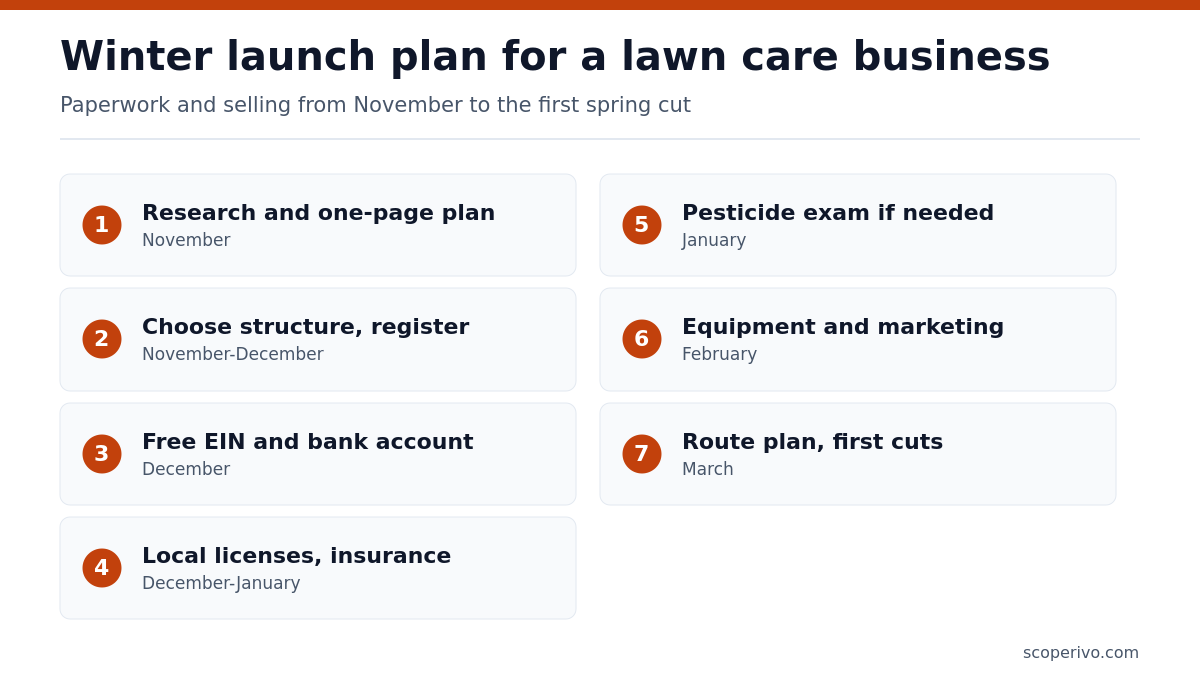
The BLS notes that some work is seasonal, available mainly in the spring, summer, and fall, and that grounds maintenance workers sometimes provide other services during the winter months, such as snow removal. That makes winter the natural time to work through how to start a lawn care business. Here is a month-by-month plan:
- November: research your area, write the one-page plan, choose a structure and ask your city or county what licenses you need.
- December: register the business, get your EIN, open a business bank account and request insurance quotes.
- January: book a pesticide exam if you plan treatments, set prices with the worksheet and set up invoicing.
- February: buy or service equipment, print door hangers, claim your Google Business Profile and start pre-selling spring cleanups.
- March: confirm first-cut dates, build your route order and send a welcome note to each new customer.
Snow removal can add winter income, but it needs its own contracts, equipment and insurance review, and you must respond to storms reliably.
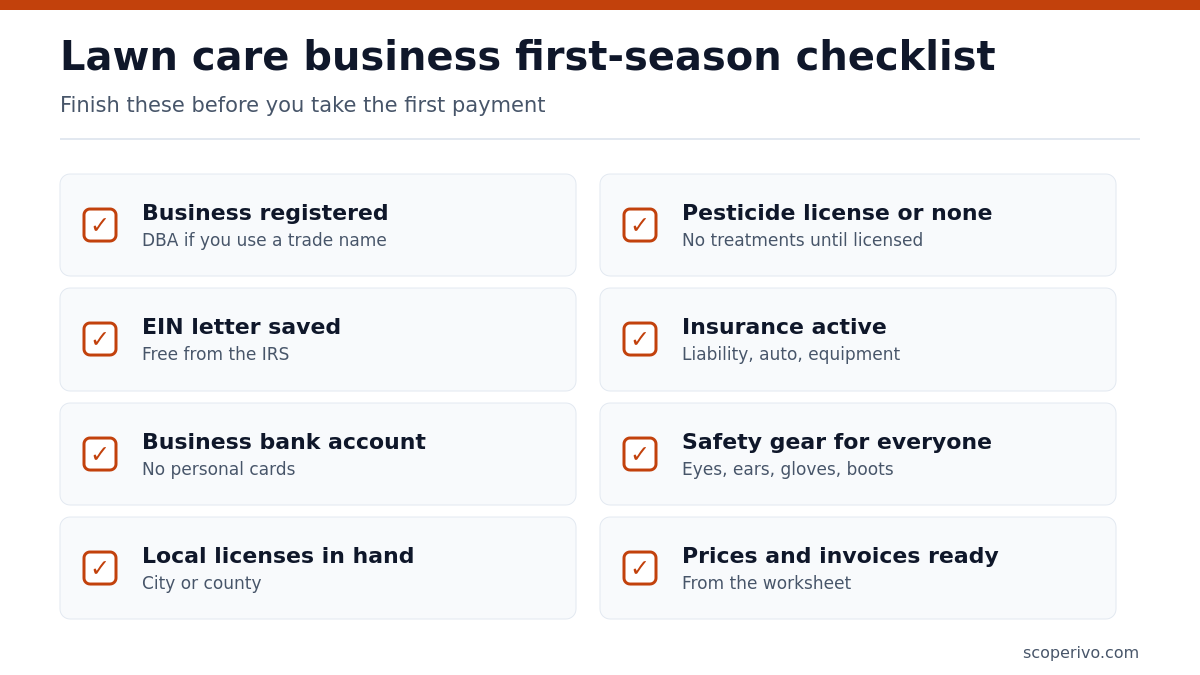
Step 10: First-season checklist
Complete every item before you take payment.
- Business registered, and DBA filed if you use a trade name.
- EIN confirmation letter saved with your formation documents.
- Business bank account open; no business costs on personal cards.
- City or county business license and any home occupation permit in hand.
- Pesticide applicator license obtained, or chemical services left off your menu.
- Liability, auto and equipment insurance active; certificates ready for commercial clients.
- Safety gear for every worker: eye and ear protection, gloves and sturdy boots.
- Price sheet built from the worksheet, and written terms for seasonal agreements.
- Invoice template ready and a way to accept card payments.
- Route order planned for your first week of customers.
Once you pass about a dozen weekly customers, a spreadsheet and paper calendar start to slow you down. Our guide to field service software for small business explains what scheduling and invoicing apps do, and our answering service for contractors guide covers how to catch calls while you are on the mower. Our guide on how to start a plumbing business follows the same registration pattern for a licensed trade.
Is a lawn care business right for you?
Ask this before you settle how to start a lawn care business: the work is physical and weather-dependent. The BLS describes it as repetitive and physically demanding, requiring frequent bending, kneeling and lifting, and it is done outdoors in all weather. It also suits self-starters: the BLS lists self-employed workers at 20 percent of grounds maintenance employment, and notes that some workers use their experience to start their own business, such as a landscaping company.
Before you commit, ask whether you can handle long summer days, cover expenses until the route fills and turn down underpriced work. Knowing how to start a lawn care business is the easy part; keeping a route profitable is the real job.
Sources and method
This guide on how to start a lawn care business was compiled on November 1, 2026 from official government pages: the SBA’s launch your business and plan your business guides, the SBA pages on business structures and licenses, the IRS pages on EINs, business structures and recordkeeping, and the BLS Occupational Outlook Handbook profile for grounds maintenance workers. It does not use third-party cost surveys. Rules differ by state and city, so confirm each legal and tax step with the official office named above.
Frequently asked questions
Do I need a license to start a lawn care business?
When you research how to start a lawn care business, expect at least a general business license from your city or county, because local governments set most licensing and permit rules. BLS says most states require licensing for workers who apply pesticides, so adding treatments brings a licensing step that a mowing-only service may not face. Check with your local licensing office and your state pesticide licensing agency before you sell services.
How much does it cost to register a lawn care business?
Registration fees depend on your state and business structure. The SBA says the total cost to register a business is less than 300 dollars in most cases, and an EIN from the IRS is free. Equipment, insurance and licenses are separate costs, so get local quotes and list them in your startup budget.
Should a lawn care business be an LLC or a sole proprietorship?
A sole proprietorship is the simplest start, but your personal and business liabilities are not separate. The SBA describes LLCs as a good fit for medium- or higher-risk businesses and owners with assets to protect. Lawn work carries injury and property damage risk, so discuss the choice with an accountant or attorney in your state.
Can I start a lawn care business in winter?
Yes. Winter is often the best time to plan how to start a lawn care business. Use November through February to write your plan, register, get an EIN, arrange insurance, sit a pesticide exam if needed and pre-sell spring cleanups. Some owners add snow removal for winter income, but it needs its own equipment, contracts and insurance review.
How do I price lawn mowing as a new business?
Price from your costs rather than copying a competitor, a rule that matters at every stage of how to start a lawn care business. Add time on site, drive time, crew size and your loaded hourly cost, then add equipment, fuel and overhead per visit and divide by one minus your target margin. Compare the result with what local homeowners say they pay, and tighten your route if your price is too high.
What equipment do I need to start a lawn care business?
For most people deciding how to start a lawn care business, a mowing-first setup needs a commercial mower, a string trimmer, an edger, a blower, a truck and trailer, hand tools and safety gear. Rent aerators and dethatchers until you have booked enough jobs, and buy spreaders and sprayers only after you hold any pesticide license your state requires.