HVAC Invoice Template: Free Service Call and Install Formats (2026)
Last updated November 1, 2026. This template guide is based on official IRS, GOV.UK, EPA and Bureau of Labor Statistics pages, checked on November 1, 2026. ScopeRivo may earn a commission from some links; read our affiliate disclosure.
An HVAC invoice template is a ready-made bill for heating and cooling work. It lists your business and the customer, the equipment you worked on (model and serial number), the diagnostic fee, labor, parts, any refrigerant added, warranty notes and payment terms. Copy the free service-call version below, or the maintenance and installation variants, and adjust each field to your business.
Every HVAC invoice template here is plain text you can paste into a document, spreadsheet or invoicing app, with placeholders such as [amount] for your own rates. The guide explains each field, shows what GOV.UK says a UK invoice must include, and summarizes what the IRS says about keeping invoices. It is general information, not legal or tax advice.
What an HVAC invoice template should include
A heating and cooling invoice does two jobs. It asks the customer for payment, and it becomes the service record that you, the homeowner and sometimes a warranty provider will look at later. Use this checklist to make sure your HVAC invoice template covers both.
- Your business name, address, phone, email and any license number your state or city asks you to show
- A unique invoice number and the invoice date
- The date the work was done, which can differ from the invoice date
- Customer name, billing address and service address
- Equipment details: type, make, model and serial number for each unit you touched
- The complaint or reason for the visit, and what you found
- Diagnostic or service call fee as its own line
- Labor, with hours or a flat-rate task description
- Parts and materials, with part numbers and quantities
- Refrigerant type and amount added or recovered, noted for the customer’s records
- Warranty notes for parts and labor
- Subtotal, any sales tax your state applies, total due and payment terms
- Technician name and customer signature or approval
If you already use our general contractor invoice template, the HVAC version adds the equipment, refrigerant and warranty sections that heating and cooling work needs.
Free HVAC invoice template for a service call
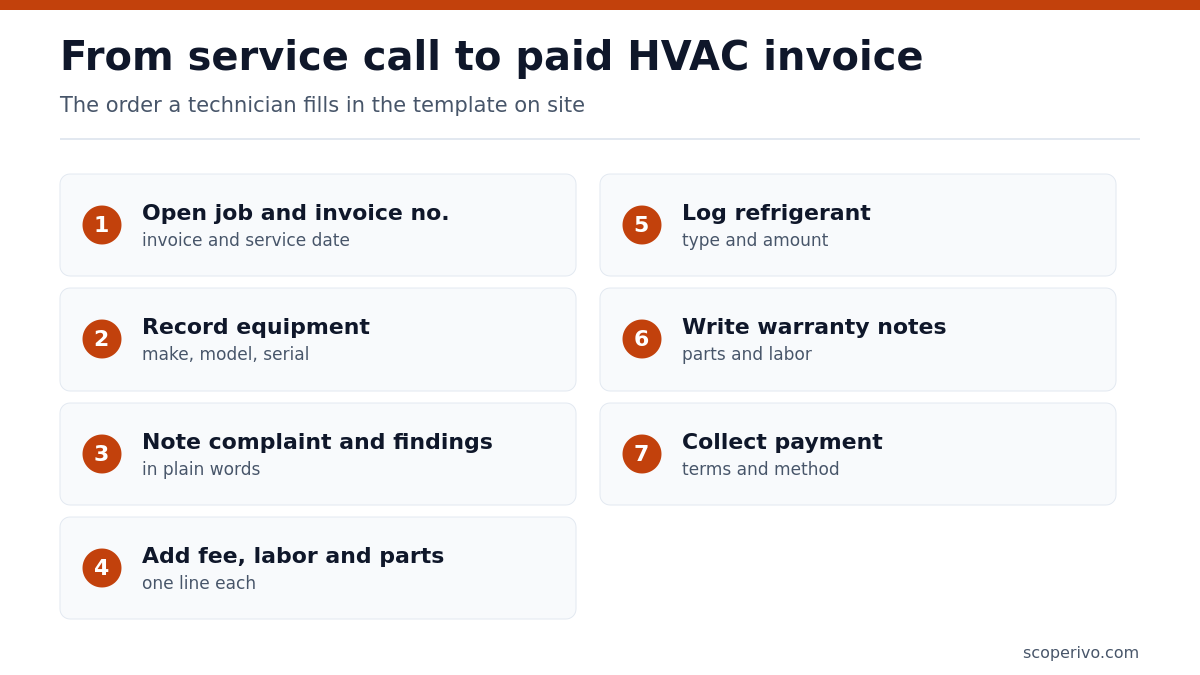
This is the core HVAC invoice template for a repair or no-heat, no-cool visit. Copy it, replace the bracketed placeholders, and delete any line you do not use. Keep the section order, because it follows the way a technician works through a call: arrive, diagnose, repair, record, bill.
[YOUR COMPANY NAME]
[Street address] | [City, State ZIP] | [Phone] | [Email]
License no.: [state or local license number, if required]

INVOICE
Invoice no.: [unique number, e.g. 2026-0147]
Invoice date: [MM/DD/YYYY]          Service date: [MM/DD/YYYY]
Work order / job no.: [reference]

BILL TO                              SERVICE ADDRESS
[Customer name]                      [Site address, if different]
[Billing address]                    [Access notes]
[Phone] | [Email]

EQUIPMENT SERVICED
Unit 1: [Furnace / heat pump / AC condenser / air handler / boiler]
  Make: [brand]   Model: [model no.]   Serial: [serial no.]
  Location: [attic / basement / closet / roof / side yard]

REASON FOR VISIT
[Customer complaint, e.g. no heat, short cycling, water leak]

FINDINGS AND WORK PERFORMED
[What you tested, what you found, what you repaired or replaced]

CHARGES                                    QTY    RATE       AMOUNT
Diagnostic / service call fee               1     [rate]     [amount]
Labor: [task or hours]                    [hrs]   [rate]     [amount]
Part: [description, part no.]             [qty]   [price]    [amount]
Part: [description, part no.]             [qty]   [price]    [amount]
Refrigerant: [type, e.g. R-410A]          [lb/oz] [price]    [amount]
Other: [disposal, after-hours, permit]    [qty]   [rate]     [amount]

Subtotal: [amount]
Discount or service plan credit: [amount]
Sales tax ([rate], if applicable): [amount]
TOTAL DUE: [amount]
Deposit or payment received: [amount]
BALANCE DUE: [amount]

REFRIGERANT RECORD (for customer records)
Type: [refrigerant]   Added: [amount]   Recovered: [amount]
Technician certification type: [Type I / Type II / Type III, as applicable]

WARRANTY
Parts: [manufacturer warranty, length]   Labor: [your labor warranty, length]
Exclusions: [e.g. damage from power surges, lack of maintenance]

PAYMENT TERMS
Due: [on receipt / within X days of invoice date]
Accepted: [card / ACH / check / cash]   Pay online: [link]

Technician: [name]          Customer approval: ______________
Notes and recommendations: [follow-up work quoted, filter size, etc.]
Field-by-field guide to the HVAC invoice template
Each section of the HVAC invoice template has a job to do. Here is what to put in each one.
Invoice number, dates and your business details
Give every invoice its own number and never reuse one, even after a void. A simple year-plus-sequence format such as 2026-0147 sorts cleanly and makes gaps easy to spot. Show both the invoice date and the service date, because a call finished late on a Friday may be billed the following week. Add your license number if your state or city expects it on customer paperwork; the Bureau of Labor Statistics notes that some states and localities require HVAC technicians to be licensed, so check with your own licensing board.
Customer, service address and equipment
Separate the billing address from the service address. Landlords, property managers and adult children paying for a parent’s repair are common reasons the two differ. Then record each unit: equipment type, make, model and serial number, plus where it sits in the building. Model and serial numbers help the next technician order the right part, support warranty claims and show which unit you worked on in a home with two systems.
Diagnostic fee, trip charge and labor
Put the diagnostic or service call fee on its own line so the customer sees it was charged for finding the problem, separate from fixing it. If you credit the fee toward an approved repair, show the credit as its own line. For labor, either list hours and an hourly rate or describe a flat-rate task, such as “replace run capacitor, test and verify operation.” After-hours premiums deserve their own line too.
Parts and materials
List each part with a short description, a part number and the quantity. A named capacitor, contactor or igniter draws fewer questions than a vague “parts and supplies” line. Keep the supplier receipt for every part with the job record; the IRS lists invoices and receipts among the supporting documents you should keep, and those receipts are also what you will need if a part fails under a manufacturer warranty.
Refrigerant line: type and amount for the customer’s records
Note the refrigerant type and the amount added or recovered on every cooling or heat pump call that involves the refrigerant circuit. Customers and future technicians can use this record to see whether a system keeps losing charge. It is also a natural place to show that the work was done by a certified technician.
The federal rules behind this come from Section 608 of the Clean Air Act. EPA’s Section 608 overview says Section 608 prohibits individuals from intentionally venting ozone-depleting substances (ODS) refrigerants and their substitutes, such as hydrofluorocarbons (HFCs) while maintaining, servicing, repairing or disposing of air conditioning or refrigeration equipment. EPA’s technician certification page says technicians who maintain, service, repair, or dispose of equipment that could release ozone depleting refrigerants into the atmosphere must be certified, and it lists Core, Type 1, Type 2 and Type 3 test topics.
Two cautions. First, EPA does not issue certification cards; cards come from the certification programs EPA lists, so list your certification type rather than an EPA card number. Second, EPA’s Section 608 pages include separate guidance on recordkeeping and reporting for certain equipment. This template’s refrigerant line is a customer courtesy, not a substitute for any record EPA requires, so read that guidance to see what applies to the systems you service.
Warranty notes
Write down two separate warranties: the manufacturer’s parts warranty and your own labor warranty. State the length of each in plain words and list common exclusions, such as damage from power surges, flooding or lack of maintenance. If a manufacturer warranty depends on product registration, add a reminder line telling the customer who registers the equipment and by when. Clear warranty notes on your HVAC service invoice save a long phone call later.
Payment terms and accepted methods
Residential service calls are often paid on completion, while commercial customers may be on agreed terms. Whatever you choose, state the due date as a date or as “due on receipt,” list the payment methods you accept and include a payment link if you have one. Rules on late fees and interest vary by state, so check your state’s rules before adding them. Sales tax on parts and labor also varies by state; your state revenue department is the place to confirm what applies.
HVAC invoice template variants: maintenance visit and installation
A tune-up and a full system replacement need different lines, so here are two shorter variants of the same HVAC invoice template.
Maintenance-visit invoice
Seasonal tune-ups are often tied to a service agreement or a one-off maintenance offer. According to the Bureau of Labor Statistics HVAC technician profile, technicians who specialize in residential systems may sell service contracts, and the service usually includes inspecting the system, cleaning ducts, replacing filters, and checking refrigerant levels. Your maintenance invoice should list each task you actually performed, so the customer can see the value of the visit.
MAINTENANCE VISIT INVOICE
Invoice no.: [number]   Visit date: [MM/DD/YYYY]
Customer: [name]   Service address: [address]
Agreement: [plan name / agreement no. / visit X of Y, or one-time]

EQUIPMENT
[Type] | Make: [brand] | Model: [model] | Serial: [serial]

CHECKLIST COMPLETED
[ ] Filter checked / replaced, size: [size]
[ ] Coils inspected / cleaned
[ ] Electrical connections and capacitors tested
[ ] Condensate drain cleared
[ ] Refrigerant pressures checked; type: [type]; added: [amount or none]
[ ] Burner / heat exchanger inspected (heating)
[ ] Thermostat operation verified

CHARGES
Maintenance visit: [amount or covered by agreement]
Additional parts: [description, qty, amount]
Refrigerant: [type, amount, price]
TOTAL DUE: [amount]

RECOMMENDATIONS (not yet approved)
[Item, reason, quote reference]
Next visit due: [month/year]
Keep recommendations separate from completed work so a customer never thinks they have been billed for a repair they did not approve. For the agreement itself, see our HVAC service agreement template, and for the technician’s task list, our HVAC maintenance checklist.
Installation or replacement invoice
Installations involve larger amounts, deposits and often a permit, so the HVAC invoice template for this work should tie back to the signed proposal. Show the deposit already received, list the new equipment with model and serial numbers, and record what happened to the old equipment and any refrigerant recovered from it.
INSTALLATION INVOICE
Invoice no.: [number]   Proposal / contract ref.: [number, date signed]
Install date(s): [dates]   Customer: [name]   Site: [address]

NEW EQUIPMENT INSTALLED
Outdoor unit: Make [brand] Model [model] Serial [serial]
Indoor unit / furnace / air handler: Make [brand] Model [model] Serial [serial]
Thermostat: [model]   Line set / ductwork: [description]

REMOVED EQUIPMENT
[Description]; refrigerant recovered: [type, amount]; disposal: [method]

CHARGES
Equipment package per proposal: [amount]
Labor and installation: [amount]
Materials: [description, amount]
Permit and inspection fee: [amount, permit no.]
Approved change orders: [ref., amount]
Subtotal: [amount]   Sales tax (if applicable): [amount]
Less deposit received [date]: [amount]
BALANCE DUE: [amount]   Due: [date or on completion]

WARRANTY AND REGISTRATION
Manufacturer parts warranty: [length]; registered by [who] on [date]
Labor warranty: [length and conditions]
If the job grew after the proposal was signed, list each approved change as its own line with a reference, rather than folding it into the equipment price.
Worked example: a no-heat call on a cold morning
Here is how the service-call HVAC invoice template fills in on a typical heating call. Amounts are left as placeholders because rates vary widely by region and business.
- Header: invoice 2026-0147, dated the same day as the visit, with the customer’s billing address and the rental property’s service address listed separately.
- Equipment: gas furnace in the basement, with make, model and serial copied from the data plate, and a photo saved to the job file.
- Reason and findings: “No heat. Inducer motor running, igniter not glowing. Igniter cracked.”
- Charges: one diagnostic fee line, one flat-rate labor line for igniter replacement and testing, and one part line with the igniter part number.
- Refrigerant record: marked “not applicable, heating call” so the customer’s file stays complete.
- Warranty: manufacturer warranty on the igniter and your labor warranty, each with its length written out.
- Payment: paid by card on site; invoice marked paid with the date and a zero balance, then emailed to the customer.
Entered this way, the visit leaves a clean record for your books and for the next technician.
Invoicing UK customers: the fields GOV.UK lists
ScopeRivo writes mainly for US contractors, but some readers work in the UK or bill UK clients. GOV.UK’s invoicing guidance sets out what an invoice must include, and the list maps neatly onto this HVAC invoice template.
- a unique identification number
- your company name, address and contact information
- the company name and address of the customer you are invoicing
- a clear description of what you are charging for
- the date the goods or service were provided (supply date)
- the date of the invoice
- the amount or amounts being charged
- VAT amount if applicable and the total amount owed
Sole traders must also show their name and any business name used, plus an address where any legal documents can be delivered to you if you are using a business name. Limited companies must show the full company name as it appears on the certificate of incorporation. GOV.UK also says you must use VAT invoices if you and your customer are VAT registered, and those carry more detail than the list above. If you are VAT registered, check the VAT invoice rules before adapting this template.
How long to keep HVAC invoices: what the IRS says
The IRS does not prescribe an invoice format. Its recordkeeping page says you may choose any recordkeeping system suited to your business that clearly shows your income and expenses. Its guide on what records to keep says supporting documents include sales slips, paid bills, invoices, receipts, deposit slips, and canceled checks, and that all requirements that apply to hard copy books and records also apply to electronic records. So a PDF made from an HVAC invoice template counts, as long as you can find and produce it.
How long you keep invoices depends on the return they support. The IRS page on how long to keep records sets out these periods for income tax returns:
| Situation (IRS) | Keep records for |
|---|---|
| General rule when the special situations below do not apply | 3 years |
| You do not report income you should have, and it is more than 25% of the gross income on your return | 6 years |
| You claim a loss from worthless securities or a bad debt deduction | 7 years |
| Employment tax records | At least 4 years after the tax is due or paid, whichever is later |
| You do not file a return, or file a fraudulent return | Indefinitely |
For many routine business records the first row applies: the general rule is to keep records for 3 years when none of the special situations apply. Longer periods apply in specific cases. For example, the IRS says to keep records for 6 years if you do not report income that you should report, and it is more than 25% of the gross income shown on your return. The IRS also notes that your insurance company or creditors may require you to keep them longer than the IRS does. Equipment records tied to property you own follow their own rule, so read the full page or ask a tax professional.
When an HVAC invoice template is enough, and when to switch to software
The BLS profile notes that HVAC technicians must maintain complete records of work performed, including the amount of time it took and specific parts and equipment that were used. A well-kept HVAC invoice template does exactly that for a small shop. It starts to strain when you have several technicians, a stack of service agreements, or customers who expect to pay online the moment the job ends.
- Stay with a template if you run one or two trucks, send a handful of invoices a week and already reconcile them in your accounting software.
- Consider software when invoices are created from work orders, maintenance visits recur on a schedule, or you lose track of who has paid.
- Connect to accounting either way; our QuickBooks for contractors guide explains the sync options.
Our HVAC software guide compares platforms that generate invoices from the job record, and HVAC dispatch software covers the scheduling side. If you also take on plumbing work, the plumbing invoice template follows the same layout so your paperwork stays consistent.
Common HVAC invoice template mistakes to avoid
- Leaving off model and serial numbers, which makes warranty claims and repeat visits harder.
- Bundling the diagnostic fee into labor, so the customer cannot see what each charge was for.
- Writing “misc. parts” instead of naming each part and quantity.
- Mixing approved work with recommendations the customer has not yet agreed to.
- Forgetting the service date when it differs from the invoice date.
- Reusing or skipping invoice numbers, which makes your books harder to reconcile.
- Omitting refrigerant type and amount on cooling calls, leaving the customer with no history of charge added.
- Sending the invoice days after the visit instead of the same day.
How we compiled this guide
We built this HVAC invoice template guide from official sources checked on November 1, 2026: the IRS pages on recordkeeping, what records to keep and how long to keep them; GOV.UK’s guidance on what an invoice must include; EPA’s Section 608 overview and technician certification pages; and the Bureau of Labor Statistics profile of heating, air conditioning and refrigeration mechanics and installers. The templates themselves are original ScopeRivo layouts. They are not legal, tax or regulatory advice, and state rules on licensing, sales tax and late fees vary, so confirm the details that apply to your business with the relevant agency.
Frequently asked questions
What should an HVAC invoice include?
An HVAC invoice should include your business details, a unique invoice number, invoice and service dates, customer and service addresses, the make, model and serial number of each unit, the reason for the visit, a diagnostic fee line, labor, itemized parts, refrigerant type and amount where relevant, warranty notes, the total due and payment terms. The free HVAC invoice template above includes all of these.
Should the diagnostic fee be a separate line?
Yes. A separate diagnostic or service call line shows the customer what they paid for finding the problem, apart from the cost of fixing it. If your policy credits the diagnostic fee toward an approved repair, add the credit as its own line so the math stays visible.
Do I need to put refrigerant on an HVAC invoice?
The sources in this guide do not say an invoice must show refrigerant, but recording the type and amount added or recovered gives the customer a useful service history. EPA Section 608 rules prohibit intentional venting and require certification for technicians who service equipment that could release ozone-depleting refrigerants. EPA also publishes separate recordkeeping guidance for certain equipment, so check whether it applies to the systems you service.
How long should I keep HVAC invoices?
The IRS says to keep records as long as needed to prove the income or deductions on a tax return. For most income tax situations that is 3 years, with longer periods in specific cases, and employment tax records are kept for at least 4 years. Insurers or lenders may want records kept longer, so check with them and with a tax professional before discarding anything.
Can I use this HVAC invoice template for UK customers?
Yes, with a few additions. GOV.UK lists the fields a UK invoice must include, such as a unique identification number, supply date, the amounts charged and the total owed. Sole traders and limited companies have extra name and address requirements, and VAT-registered businesses must issue VAT invoices with more detail. Add those fields before using the template for UK work.
Is an HVAC invoice template better than invoicing software?
A template is enough for a small shop that sends a handful of invoices a week and keeps good records. Software becomes worth it when you run several technicians, recurring maintenance agreements or online payments, because it creates the invoice from the work order automatically. Moving the same fields into software later keeps your records consistent.