HVAC Maintenance Checklist: Free Printable for Homes and Commercial Units (2026)
Last updated October 25, 2026. These checklists draw on ENERGY STAR, EPA and OSHA guidance pages, read on October 25, 2026. ScopeRivo may earn a commission from some links; read our affiliate disclosure.
An hvac maintenance checklist is a dated list of inspections done twice a year by a technician, cooling in spring and heating in fall, plus simple monthly tasks for the owner. It covers filters, electrical connections, coils, the condensate drain, refrigerant charge, gas burners and controls. Copy the free printable versions below for homes and commercial rooftop units.
Download the free printable hvac maintenance checklist
Printable PDF, 4 pages: spring cooling, fall heating, monthly owner checks with sign-off, and commercial rooftop units. No sign-up needed.
What a complete hvac maintenance checklist covers
Federal guidance gives a solid starting point. ENERGY STAR recommends having a contractor do annual pre-season check-ups, and it suggests timing them so you check the cooling system in the spring and the heating system in the fall, before contractors get busy. Between visits, the owner handles filters and keeps equipment clear. The table below shows how the work splits up across the year.
| Task group | When | Who | Why it matters |
|---|---|---|---|
| Air filter check and change | Monthly check | Homeowner or building staff | Dirty filters restrict airflow and raise energy use |
| Thermostat settings and controls | Spring and fall | Technician (owner can check settings) | Confirms the system starts, runs and shuts off correctly |
| Electrical connections, voltage and motor current | Spring and fall | Licensed technician only | Loose connections are a safety risk and shorten component life |
| Coils, blower and airflow | Spring (cooling focus) | Technician | Dirty coils and poor airflow reduce capacity and efficiency |
| Refrigerant charge | Spring | EPA Section 608 certified technician | Wrong charge lowers efficiency; venting is prohibited |
| Gas connections, burner, heat exchanger | Fall (heating focus) | Licensed technician only | Fire and carbon monoxide safety |
| Condensate drain | Spring and fall | Technician; owner can watch for leaks | A clogged drain can cause water damage and humidity problems |
Each part of this hvac maintenance checklist gives a copy-ready list inside a gray box, followed by short notes on why the items are there. Print them, paste them into a work order, or load them as checklist items in your field service app.
Spring cooling tune-up checklist
Spring is the time to get the air conditioner or heat pump ready for summer load. This spring hvac maintenance checklist combines the general check-up items ENERGY STAR describes with the cooling-specific work a technician performs. Items marked TECH need a trained professional with the right meters and, for refrigerant, federal certification.
HVAC MAINTENANCE CHECKLIST - SPRING COOLING TUNE-UP
Customer: [name]          Address: [address]
Equipment: [AC / heat pump / ductless]   Model/serial: [numbers]
Visit date: [date]        Technician: [name]

GENERAL
[ ] Review thermostat settings and schedule with customer
[ ] Inspect / replace air filter (size: [size], rating: [MERV])
[ ] TECH: Tighten electrical connections
[ ] TECH: Measure voltage and current on motors (record: [readings])
[ ] TECH: Lubricate moving parts where required
[ ] TECH: Check system controls for safe operation
[ ] TECH: Check starting cycle - starts, runs, shuts off properly
[ ] Inspect and flush condensate drain and trap

COOLING SPECIFIC
[ ] TECH: Clean evaporator coil (or note access limits)
[ ] TECH: Clean outdoor condenser coil; clear debris around unit
[ ] TECH (EPA 608 certified): Check refrigerant charge; adjust if needed
[ ] TECH: Inspect refrigerant lines and insulation
[ ] TECH: Clean and adjust blower components for proper airflow
[ ] Check supply and return registers are open and unblocked
[ ] Record supply / return temperatures: [readings]

NOTES / RECOMMENDED REPAIRS
[notes]

Customer initials: [initials]
Why each cooling task matters
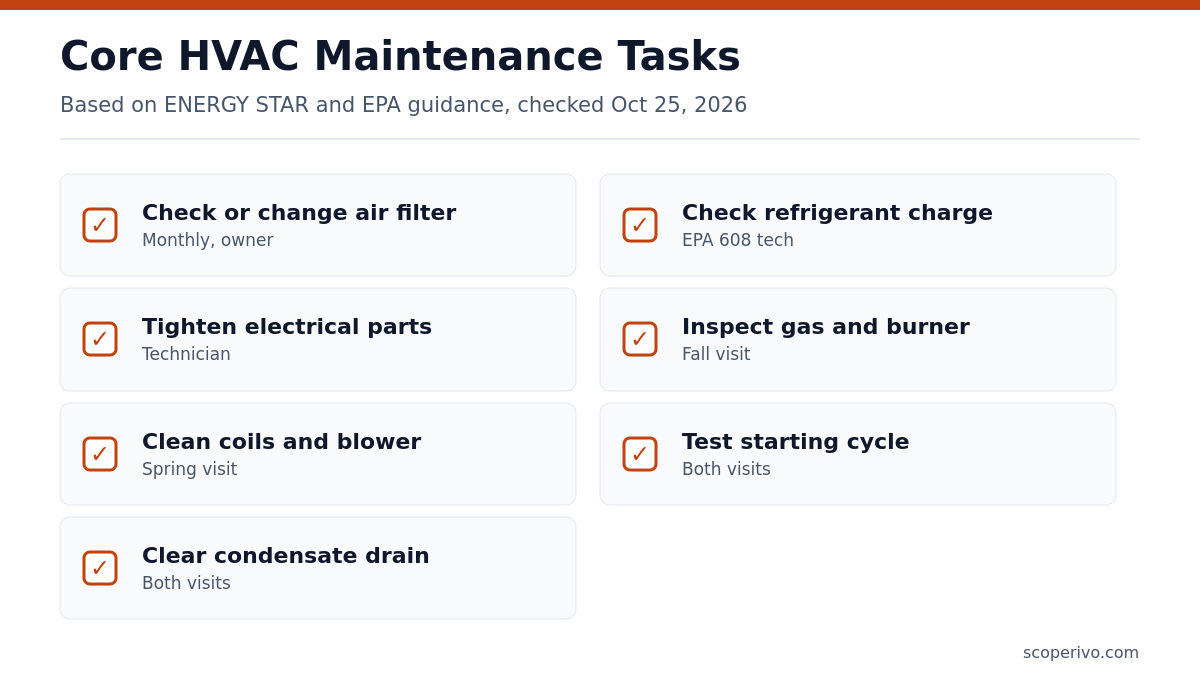
Coil cleaning comes first for a reason. ENERGY STAR explains that dirty coils make the system run longer to cool the home, which raises energy costs and wears equipment. Blower cleaning and adjustment protect airflow, and the agency notes that airflow problems can reduce your system’s efficiency by up to 15 percent. Electrical checks matter because faulty electrical connections can cause unsafe operation of your system and reduce the life of major components.
Refrigerant is the item homeowners most often misunderstand. A unit is not supposed to “use up” refrigerant; low charge usually means a leak. ENERGY STAR notes that too much or too little refrigerant will make your system less efficient, so the technician should measure rather than top off by habit. The condensate drain is easy to overlook, yet a plugged drain can cause water damage in the house and affect indoor humidity levels, which is why it appears on both seasonal lists.
Fall heating tune-up checklist
The fall visit focuses on the furnace, boiler or heat pump in heating mode. The general items repeat because electrical connections loosen and drains clog regardless of season. The heating-specific items are where safety matters most, which is why this section of the hvac maintenance checklist is technician-only.
HVAC MAINTENANCE CHECKLIST - FALL HEATING TUNE-UP
Customer: [name]          Address: [address]
Equipment: [gas furnace / oil furnace / heat pump / boiler]
Model/serial: [numbers]   Visit date: [date]   Technician: [name]

GENERAL
[ ] Review thermostat heating schedule with customer
[ ] Inspect / replace air filter
[ ] TECH: Tighten electrical connections; measure voltage and motor current
[ ] TECH: Lubricate moving parts where required
[ ] TECH: Check controls and safety switches
[ ] TECH: Verify starting cycle - ignition, run, shutdown
[ ] Inspect condensate drain (high-efficiency furnace / heat pump)

HEATING SPECIFIC (licensed technician only)
[ ] Check all gas (or oil) connections for leaks
[ ] Measure gas pressure: [reading]
[ ] Inspect and clean burner; check flame and combustion
[ ] Inspect heat exchanger for cracks or corrosion
[ ] Check flue / venting for blockage and secure joints
[ ] Test carbon monoxide alarm near equipment (advise customer)
[ ] Heat pump: check defrost operation and auxiliary heat

NOTES / RECOMMENDED REPAIRS
[notes]

Customer initials: [initials]
Gas and combustion safety items
ENERGY STAR lists checking gas or oil connections, gas pressure, burner combustion and the heat exchanger as the core heating tasks, and it is blunt about why: improperly operating gas (or oil) connections are a fire hazard and can contribute to health problems. A dirty burner or a cracked heat exchanger can make equipment run less safely and less efficiently. Homeowners should never open burner compartments or adjust gas valves; if you smell gas, leave the building and call your gas utility from outside.
Heat pumps need the same electrical and airflow attention in fall as in spring, plus a check of defrost controls and backup heat. For dual-fuel systems, run both stages so you know the changeover works before the first cold night.
Monthly homeowner tasks
Owners can do a lot between professional visits, and none of it requires tools beyond a flashlight. ENERGY STAR’s list of actions to do yourself starts with one habit: inspect, clean, or change air filters once a month in your central air conditioner, furnace and/or heat pump. Your contractor can show you where the filter sits and which way the airflow arrow should point.
MONTHLY HOMEOWNER HVAC MAINTENANCE CHECKLIST
Month: [month]   Home: [address]

[ ] Check air filter; replace if dirty (date replaced: [date])
[ ] Keep supply and return vents clear of furniture, rugs and boxes
[ ] Clear leaves, grass clippings and debris from around the outdoor unit
[ ] Look for water around the indoor unit or drain line
[ ] Listen for new noises: rattling, squealing, banging
[ ] Confirm thermostat schedule still matches your routine
[ ] Check that carbon monoxide and smoke alarms work
[ ] Note any rooms that are too hot or too cold
[ ] Book the spring or fall tune-up if it is not on the calendar

Problems noticed: [notes]
Call: [contractor name and phone]
Filters: how often and which rating
Filter timing depends on your home. ENERGY STAR says to check the filter every month, especially in heavy-use months, and at a minimum, change the filter every 3 months. The EPA adds that manufacturers typically recommend replacement every 60 to 90 days, and that heavily soiled filters are a sign you should change them more often. Pets, construction dust and long run times all shorten filter life.
On filter rating, the EPA suggests choosing a filter rated at least MERV 13, or as high as your system fan and filter slot can accommodate. It explains that filters with a MERV of 13 and above are required to demonstrate at least 50% removal efficiency for the smallest particles tested. Because a denser filter can restrict airflow in some systems, ask your technician to confirm what your equipment can handle before upgrading.
Ductless and window units
Mini-split heads and window units need their own line on the owner list. Their washable filters sit behind the front panel and clog quickly in kitchens and bedrooms with pets. The EPA notes that most window air conditioners and wall-mounted units are intended for temperature control rather than air filtration, so cleaning their screens protects the equipment but will not do much for fine particles. Add a line to your monthly hvac maintenance checklist for rinsing these screens, and have a technician clean the indoor coil and blower wheel during the seasonal visit.
Commercial rooftop unit (RTU) checklist
Packaged rooftop units serve many small commercial buildings, from restaurants to retail strips. They face sun, wind and debris year-round, and they are often out of sight until a tenant complains. ENERGY STAR’s commercial checklist recommends that buildings regularly change or clean HVAC filters every month during peak cooling or heating season and clean the evaporator and condenser coils on heat pumps, air conditioners and chillers.
HVAC MAINTENANCE CHECKLIST - COMMERCIAL ROOFTOP UNIT (RTU)
Site: [building name]     Unit ID / location: [RTU-#]
Tonnage / fuel: [details] Model/serial: [numbers]
Visit: [date]  Technician: [name]  Season: [spring / fall / quarterly]

SAFE ACCESS
[ ] Roof access, ladder and fall protection reviewed before work
[ ] Disconnect located; lockout/tagout applied where required

AIR SIDE
[ ] Replace filters (qty / size: [details])
[ ] Inspect belts for wear and tension; replace as needed
[ ] Check blower wheel, bearings and motor; lubricate if required
[ ] Check economizer dampers, linkage and controls
[ ] Inspect cabinet panels, gaskets and door seals
[ ] Inspect curb and duct connections for air leaks

COOLING / REFRIGERATION
[ ] Clean condenser and evaporator coils
[ ] TECH (EPA 608 certified): Check refrigerant pressures; record
[ ] Inspect compressor contactors and capacitors
[ ] Clear and flush condensate pan and drain

HEATING (gas-fired RTU)
[ ] Inspect burners, igniter and flame sensor
[ ] Check gas pressure and connections for leaks
[ ] Inspect heat exchanger and flue

CONTROLS
[ ] Verify thermostat / building controls schedule matches occupancy
[ ] Calibrate space sensor; confirm setpoints

Readings: [supply temp] [return temp] [amps] [pressures]
Findings / quote needed: [notes]
Roof access and other safety notes
RTU work usually means climbing to a roof, and falls are a serious risk. OSHA notes that falls are among the most common causes of serious work related injuries and deaths, and its fall protection page explains that OSHA requires that fall protection be provided at elevations of four feet in general industry workplaces, with different heights for construction and other sectors. Which rule applies depends on the work, so employers should confirm requirements with OSHA directly rather than relying on this summary.
A commercial hvac maintenance checklist also benefits from attention to the space itself. ENERGY STAR points out that as much as 25 percent more energy is required to distribute air if your vents are blocked, so the building walk-through should include checking that shelving and stock are not covering supply or return grilles.
Homeowner tasks vs licensed technician tasks
A good hvac maintenance checklist makes the line between owner and professional obvious. Anything involving gas, line-voltage electrical work or refrigerant belongs to a trained, licensed technician. Licensing rules vary by state and city, so check with your state licensing board if you are unsure who may perform a given task.
| Homeowner or building staff can | Licensed technician should |
|---|---|
| Check and replace air filters | Measure voltage and amperage; tighten electrical connections |
| Keep vents and the outdoor unit clear | Clean coils and blower assemblies |
| Set and review the thermostat schedule | Check and adjust refrigerant charge (EPA 608 certification) |
| Watch for leaks, odors and unusual noises | Inspect gas connections, burners and heat exchangers |
| Test smoke and carbon monoxide alarms | Test safety controls, flue and venting |
Refrigerant work and EPA Section 608
Refrigerant is regulated under federal law. The EPA states that technicians who maintain, service, repair, or dispose of equipment that could release ozone depleting refrigerants into the atmosphere must be certified under Section 608 of the Clean Air Act. The certification has a Core exam plus Type 1 (small appliances), Type 2 (high-pressure) and Type 3 (low-pressure) categories, explained on the EPA technician certification page. Section 608 also prohibits individuals from intentionally venting ozone-depleting substances (ODS) refrigerants and their substitutes, which include HFCs. Homeowners should not attempt refrigerant work, even with store-bought recharge kits.
Technician sign-off section
A signed hvac maintenance checklist protects both sides. It shows the customer what was done, supports warranty claims that require proof of maintenance, and gives the next technician a baseline. Add this block to the bottom of any checklist above.
TECHNICIAN SIGN-OFF
Visit type: [spring cooling / fall heating / RTU / other]
All checklist items completed: [ ] Yes  [ ] No - see exceptions
Exceptions / items not performed and why: [notes]

Key readings recorded: [ ] Electrical  [ ] Temperatures  [ ] Refrigerant  [ ] Gas pressure
Safety concerns found: [ ] None  [ ] Yes - customer informed in writing
Refrigerant added or recovered: [type] [amount]  (EPA 608 cert #: [number])
Recommended repairs and quote number: [details]
Next scheduled visit: [date]

Technician name: [name]   License #: [number]
Technician signature: ____________________   Date: [date]

Customer name: [name]
Customer signature: ____________________     Date: [date]
Keep the signed copy with the customer record. If you use paper, scan it the same day; if you use an app, capture the signature on the tablet and attach photos of the data plate and any problem areas.
How contractors can use this hvac maintenance checklist
For HVAC companies, checklists are more than paperwork. They are the backbone of maintenance agreements, a consistent quality standard across techs, and a record that supports repair recommendations. ENERGY STAR’s commercial guidance even suggests buildings tune up their HVAC system with an annual maintenance contract so pre-season visits happen automatically.
Tie the checklist to a maintenance agreement
Your agreement should name the visits included, what each visit covers and what counts as a repair outside the plan. Attaching the spring and fall lists to the contract removes any argument about scope. Our HVAC service agreement template has clauses for visit frequency, priority service and renewal that pair well with these lists.
Load the lists into your software
Most field service platforms let you build checklists that techs complete on a phone, with required fields, photos and signatures. Load each hvac maintenance checklist as a job template so every tune-up generates the right list automatically. If you are still choosing a platform, see our guide to HVAC software, and use a CRM to track agreement renewals and equipment history; our CRM for HVAC guide compares options. For one-off jobs, a work order template can carry the same checklist on paper.
- Create separate templates for spring cooling, fall heating and RTU visits.
- Make readings such as voltage, amperage and temperatures required fields.
- Require a photo of the data plate on the first visit to build an equipment record.
- Auto-schedule the next seasonal visit when the current one closes.
- Send the completed checklist to the customer as a PDF with recommendations.
Train techs to note exceptions rather than tick every box. An honest “not performed, no access to evaporator coil” builds more trust than a perfect-looking form that does not match the work.
How to print and customize this hvac maintenance checklist
The gray boxes are plain text on purpose, so they paste cleanly into a word processor, a spreadsheet or the checklist builder in your field service app. Replace each bracketed placeholder with your own details, add your company name, phone number and license number at the top, and save a master copy before you edit it for a specific customer.
- Add equipment-specific lines from the manufacturer, such as humidifier pads, UV lamps or air purifier cartridges.
- Remove lines that never apply, such as gas items for an all-electric home, so techs are not tempted to tick boxes by habit.
- Print the homeowner list on one page and leave it by the furnace or air handler.
- Date each revision so you know which version of the hvac maintenance checklist a past visit used.
Sources and method
ScopeRivo wrote this hvac maintenance checklist set from official guidance read on October 25, 2026: the ENERGY STAR maintenance checklist, ENERGY STAR’s heating and cooling efficiency tips, the ENERGY STAR commercial checklist of energy-saving measures, the EPA guide to air cleaners in the home, the EPA Section 608 pages and OSHA’s fall protection page. Additional items such as belts, economizers and carbon monoxide alarms reflect common industry practice and are presented as suggestions, not requirements. We cite efficiency figures only where the source states them. Always follow the equipment manufacturer’s instructions, which take priority over any general list.
Frequently asked questions
What should an HVAC maintenance checklist include?
A complete hvac maintenance checklist should include thermostat and control checks, electrical connection and motor checks, lubrication, condensate drain cleaning and a starting-cycle test. Cooling visits add coil cleaning, refrigerant charge and blower adjustment; heating visits add gas connections, gas pressure, burner combustion and heat exchanger inspection. Monthly owner tasks center on filters and keeping vents and outdoor units clear.
How often should HVAC maintenance be done?
ENERGY STAR recommends a professional check-up once a year for each system before its season: cooling in spring and heating in fall. A heat pump that does both jobs benefits from both visits. Owners should check filters monthly during heavy-use seasons and replace them at least every three months, or sooner if they look dirty.
Can I do HVAC maintenance myself?
You can handle filter changes, clearing vents and the outdoor unit, checking thermostat settings and watching for leaks or noises. Leave electrical measurements, coil cleaning inside the cabinet, refrigerant work and anything involving gas to a licensed technician. Refrigerant handling requires EPA Section 608 certification, and gas work carries fire and carbon monoxide risks.
What filter rating should I use?
The EPA suggests a filter rated at least MERV 13, or the highest rating your system fan and filter slot can accommodate. Most systems can take a MERV 13 filter if it is changed often, but some cannot. Ask your technician to confirm before upgrading, and make sure the filter fits snugly without gaps.
Is a commercial RTU checklist different from a home checklist?
Yes. Rooftop units add belts, economizers, cabinet seals, curb connections and building control schedules, and they often need more frequent filter changes during peak seasons. Access is also different: technicians work on roofs, so fall protection and lockout procedures belong at the top of the list. Gas-fired RTUs still need burner and heat exchanger checks.
Why do maintenance agreements use checklists?
An hvac maintenance checklist defines exactly what each included visit covers, so customers know what they paid for and techs deliver the same standard every time. It also creates a dated record of readings and findings that supports repair quotes, warranty claims and renewal conversations. Many contractors load the list into field service software as a required job template.